The status quo of the higher education system analysis
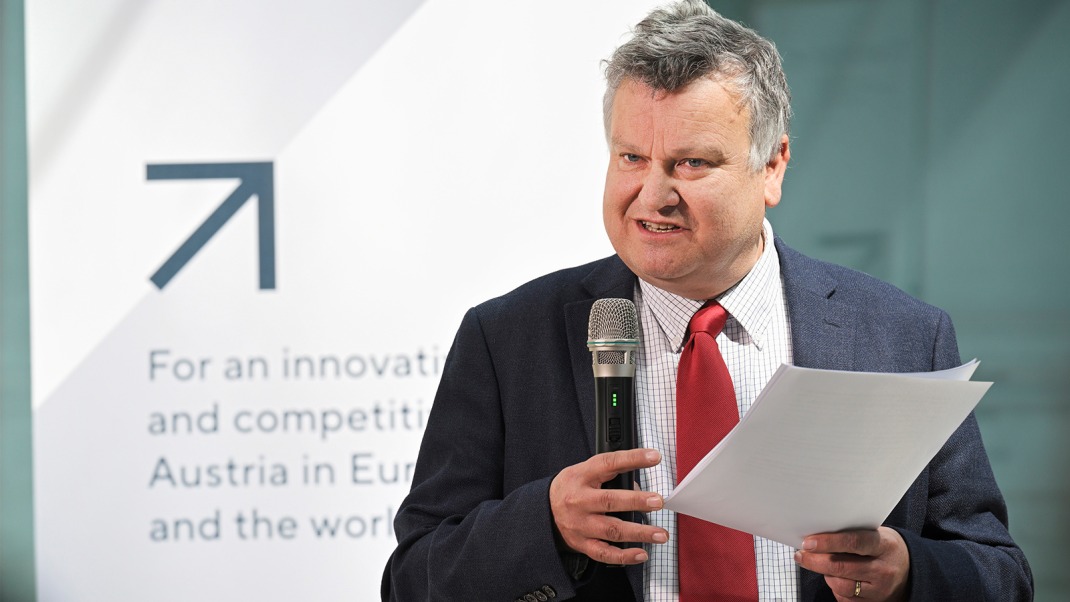
This is a translation of the transcript of the presentation on the status quo of the analysis of the Austrian higher education system, on the occasion of the launch of the development process for the Higher Education Strategy 2040 by Federal Minister Eva-Maria Holzleitner on 3 December 2025 at the Aula der Wissenschaften in Vienna.
***
Minister, Ladies and Gentlemen, thank you for the opportunity to speak here today as Chairperson of the Council for Sciences, Technology, and Innovation regarding our contribution to the Higher Education Strategy 2040.
The Federal Government has requested that we undertake an analysis of the Austrian higher education system—effectively an assessment of the status quo—to serve as a foundation for developing the Higher Education Strategy 2040. I am very pleased to follow the previous speakers—Minister Holzleitner and Lisz Hirn—who both made it clear how vital universities are to a modern society.
“Higher education institutions are essential for the innovative strength and economy of our country.”
Thomas Henzinger
Earlier, during an interview, I was asked whether universities will still be needed in the year 2040. Of course, it was a rhetorical question, but we should answer it nonetheless. Universities are important for at least two reasons. Firstly, as we have already heard, they are an indispensable component of a resilient democracy. We have spoken less about the second reason today, which is why I wish to explicitly emphasise it once more: higher education institutions are essential for the innovative strength and the economy of our country.
Excellent scientific education and innovative research are the guarantors of our prosperity. Our universities are Austria’s future. But what is the current state of the Austrian higher education system? From what starting point will it be transformed by the future Higher Education Strategy up to 2040? These are the questions guiding our contribution—the analysis of the higher education system. Together with the members of the FORWIT working group—Jörg Flecker, Theresia Vogel, and external expert Jürgen Janger (WIFO)—we began our work in September by establishing an initial overview.
What is immediately apparent is the complexity of the system. Universities fulfil many different roles in our society. If the system were a company, one would demand more focus. However, the diverse tasks of universities are all of significance and importance; we cannot simply scrap certain tasks in favour of others deemed more important.
“Our analysis follows the three classic, core missions: teaching, research, and the third mission.”
Thomas Henzinger
We have decided to organise our analysis along the three classic, core missions: teaching, research, and the third mission. In our analysis, we subdivide each of these three missions into two fields of impact for which they provide added value: one for Austrian society and one for the country’s economic innovative strength. To make the system’s performance at least approximately measurable and internationally comparable, we are examining potential quantitative indicators to help us robustly analyse each of these six impact areas.
The mission of teaching for our society is to enable tertiary education for as broad and diverse a segment of the population as possible. For the needs of our economy, and thus the labour market, it offers modern, high-quality initial and continuing education programmes.
The mission of research for society is to enable curiosity-driven research at the highest level and to contribute to the expansion of global knowledge. This is what is generally known in Austria as basic research. Regarding the economic impact area, universities address relevant questions from industry and society through their research.
And finally, the third mission, which has the broadest spectrum of all three tasks and for which one must select representative examples. We can certainly postulate that Austria’s universities act as cosmopolitan centres for evidence-based discourse at both regional and national levels. I believe this is a vital role for universities that we must not underestimate. The third mission is also of essential importance for our prosperity: Austria’s universities are the starting points for knowledge-based innovation and new entrepreneurial success.
These are the three missions of our universities and their six impact areas.
I believe it is clear that we have a solid higher education system that fulfils these tasks well in many areas and possesses significant strengths: free access to higher education, good vocational training, excellent researchers, diverse collaborations with industry, a continued high level of social prestige, and, of course, the clear commitment of the public sector to university funding.
“Can we assume that our current strengths will still be strengths in 15 years’ time?”
Thomas Henzinger
But is this enough for the university of 2040? Can we assume that our current strengths will still be strengths in 15 years, and that they will still help us to hold our own in international competition? I believe we must have significantly improved our universities by then; the university of 2040 cannot be the same as the university of the 20th century if it is to fulfil its core missions effectively. Therefore, I believe we must be clear about which challenges and weaknesses we need to address. Some have already been mentioned, but I would like to go into them explicitly once more.
At FORWIT, we see three major thematic areas where there is certainly room for improvement. I will outline them under the following titles: “Studying in Austria”, “What will the university of 2040 look like?” and “Funding and Autonomy”.
Studying in Austria. We consider this topic particularly important and established a working group roughly a year ago—long before there was any talk of a higher education analysis or strategy, or the current Federal Government.
If you speak with international academics about studying in Austria, you quickly realise how uniquely non-binding the organisational processes of studying are here by international standards. Nevertheless—or perhaps because of this—we speak of two clear challenges: the low higher education attainment rate and the low level of social diversity. I believe the objective in the 21st century must be to increase the attainment rate—the proportion of the population with a degree. This is a substantial contribution to a resilient democracy, to our innovative strength, and to tapping into the talent potential within the population. If you speak to experts, you will learn that labour market flexibility and equal opportunities increase with educational levels. We are not even discussing which degrees are more or less relevant, or what the industry’s demand for skilled workers is. The more education a person receives, the more capable of learning they become. And the ability to learn is a decisive—if not the only truly reliable—competence in today’s working world, where we do not know what job profiles will look like in ten or twenty years. The societal goal must be to have as many people as possible in the country who are capable of learning. This does not harm our democracy; on the contrary.
Therefore, I believe—even if some say it is too radical—that we should set a target for a higher education attainment rate of 50%. We are currently at just under half that. How can we effectively increase this rate? I believe there are two very important levers: studying must be predictable and affordable.
“I would highlight the problem of a lack of commitment, and from all sides: the students, the universities, and higher education policy.”
Thomas Henzinger
Both factors primarily affect those from less educated backgrounds and children from non-academic families. One thinks twice about studying if it is unclear when the degree can be completed and whether a part-time job is required. I would wish for every first-year student to have a bachelor’s degree after three years. I would highlight the problem of a lack of commitment here, from all sides: the students, the universities, and higher education policy.
What will the university of 2040 look like? No one has a crystal ball, but it is clear that we need a dynamic higher education system that responds to demographic, technological, and geopolitical shifts, and that continuously develops and changes. Demographic change is self-explanatory. Technological change is also clear: here we are talking, for example, about studies shifting further online and learning moving even more away from content towards competences. Why geopolitical? Generations of students from all over the world have moved to the USA. Now, those paths are being questioned. This presents an opportunity for Austria. As a country, we should consider how we want to handle this.
We need a higher education system with strong intrinsic innovative capacity, capable of reforming itself without the need for new foundations, of renewing itself independently, and of adapting to extrinsic processes of change. A system that thereby becomes internationally competitive and so attractive that the best minds choose Austria. To achieve this, we must also talk honestly about the deficits in traditional academic career paths, which are still largely anchored in the structures of the 20th-century university. They are also characterised by silos and almost non-existent vertical permeability.
Our goal should be to get young, competitive researchers into independent, secure positions quickly and at a relatively young age. In parallel, it would be sensible to establish further science-related career paths for roles in teaching, research infrastructure, science management, science communication, and technology transfer. These are all academic careers that do not have the traditional professorship or Principal Investigator role as their final destination.
“How can funding create an effective incentive system that links input and output?”
Thomas Henzinger
This brings me to the third and final field of challenge: funding, autonomy, and how these two aspects interact. I see here, firstly, the problem of an ineffective distribution apparatus—a phenomenon we also observe in other areas of the Austrian research, technology, and innovation system: output is not directly linked to input. How can funding create an effective incentive system that links input and output, rewards performance, and plans and manages with cost-truth based on actual figures?
Secondly, the institutional branding of universities is a key success factor. You all know Stanford, Harvard, or Oxford. The institution is the brand used to recruit students on the global market. It is not the consortium of institutions, and it is not the small sub-department. All of that dilutes the brand, and this is hardly understood in Austria. If we want to have over 70 higher education institutions in Austria, they must all be distinguishable from one another—including internationally. They should all form their own brand and be attractive to a specific group of students.
In addition to the core missions of teaching and research, it is important for branding—and beyond—to pay attention to the interfaces of universities. Universities do not exist in isolation; they are a vibrant part of society. We are speaking here of the interface between schools and universities, the interface between universities and non-university research, and the interface between universities and industry. But also the interfaces with administration and politics, regions and society, and finally the international interface with Europe and beyond.
In closing, I would like to give you a brief insight into our analysis process and an outlook for the future. A systemic analysis gains robustness when an independent external perspective and learning from the experiences of other countries are included. To incorporate this important aspect, we have recruited four distinguished experts for an international Sounding Board: Rachel Brooks (Professor of Higher Education, University of Oxford), Lino Guzzella (former President of ETH Zurich), Ingvild Reymert (Higher Education and Research Policy Scientist, Oslo Metropolitan University), and Robert-Jan Smits (former President of TU Eindhoven and former Director-General for Research and Innovation at the European Commission). The Sounding Board will meet for the first time here in Vienna on 5 December. One of the first topics will be the discussion and identification of meaningful and representative indicators.
There will be two further working sessions with the Sounding Board, the third at the end of March. We hope to hand over our report to Minister Holzleitner and the Federal Government in early April.
Thank you for your attention.