Blog
Sweden, Switzerland, the Netherlands – and Austria: Lessons from Europe’s Best Innovation Systems
16 September 2026

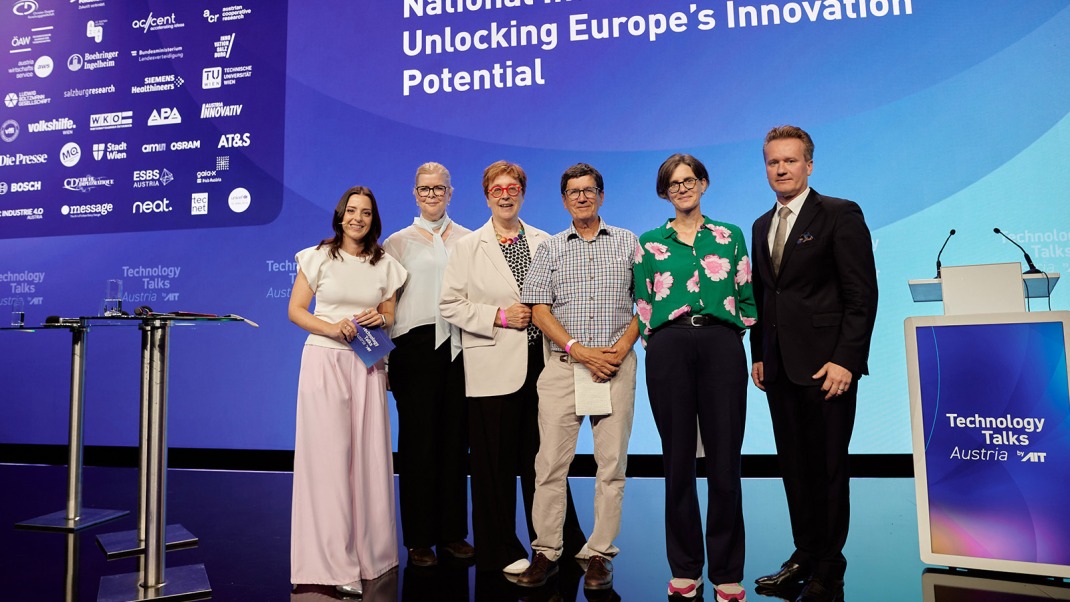
At this year’s Technology Talks Austria, I had the special opportunity to discuss national innovation systems and their contribution to Europe’s performance in the closing panel with four outstanding figures: Malin Frenning, CEO of the Research Institutes of Sweden (RISE); Annelieke van der Giessen of the Dutch Advisory Council for Science, Technology and Innovation (AWTI); Dominique Foray, Professor Emeritus at École Polytechnique Fédérale de Lausanne (EPFL) and member of the Swiss Science Council; and Georg Knill, President of the Federation of Austrian Industries. The questions that united us are ones that preoccupy me and my fellow council members at FORWIT every day: How can we effectively strengthen Austria’s and Europe’s innovation system? Which societal, political and economic configurations help, and which hinder?
The answers were as substantive as they were numerous. I would therefore like to reflect on the insightful exchange on the panel and to summarise those aspects presented that, from my point of view, are absolutely essential to Europe’s performance and, coming from the perspective of small countries or economies respectively, are of particular interest to Austria.
Sweden: Trust, cooperation, internationality – and early adopters
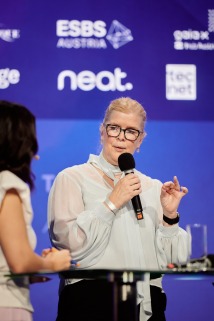
Malin Frenning (RISE)
© Katharina Schiffl
Malin Frenning reminded us that Sweden’s success is by no means a given. Around 1900, the country was small, rural and poor; 1.5 million Swedes emigrated. Over generations, investment in education, strong public institutions and a progressive industrial base gave rise to that innovation system which is today regarded as leading in the EU – with Stockholm as Europe’s most innovative region.
She highlighted four critical factors: (i) consistently high levels of trust between the population, institutions and technology, (ii) close cooperation between science, industry, research institutions and the public sector, (iii) internationalisation, because the domestic market was simply too small, and (iv) early adopters.
For me, the last factor was a particularly significant one: Sweden was a pioneer in mobile phones, computers and the internet; the population was mobilised and became a test market that generated demand and gave companies room to experiment and improve. This corresponds precisely to the idea of using the domestic market as a testbed, for example through pre-commercial procurement. We have applied this approach in Austria in certain areas of energy technology – and I am convinced that this instrument can and should be deployed far more widely in our country. An important added benefit is the considerably faster time to market thanks to a development environment on a real-world scale.
The Netherlands: It is not the level of funding that is decisive, but how it is used
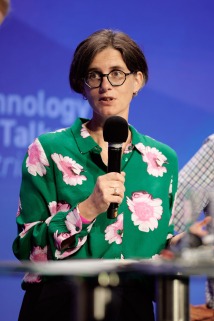
Annelieke Van Der Giessen (AWTI)
© Katharina Schiffl
Annelieke van der Giessen challenged us to reflect with an observation: the Netherlands has never achieved the European target of a 3 per cent R&D ratio, yet still ranks third in the European Innovation Scoreboard. So what evidently matters less is the level of funding than how it is deployed: stable core funding for science, generic support for industry, combined with highly competition-oriented funding for missions and key technologies – defined not by government, but in the triple and quadruple helix, that is, jointly by politics, science, business and society.
At the same time, she was unsparingly critical: too much innovation activity is concentrated in a handful of large companies – ASML alone invests as much in R&D as the next eight companies combined. Moreover, there is a shortage of technical talent, and the Netherlands, too, is affected by the innovation paradox: excellent science and research run up against difficulties in transferring results into commercialisation and scaling. The answers – an agency for disruptive innovation, a national investment bank, a talent strategy, a stronger focus on public procurement – fell on receptive ears with me, and not only with me.
What I admire about the Netherlands is its uncompromising competitive mindset: taking pride in what has been achieved, but not shying away from competition. This, too, could be pushed further in Austria. Conversely, as van der Giessen emphasised, the Netherlands is currently learning from Austria how to better align its own ambitions with European ones – a fine example of the fact that some things work better in this country than they do among Europe’s innovation leaders. To these I would also count our culture of cooperative research, that is, the involvement of industry, research institutions and, crucially, SMEs in research programmes. In a country that consists of more than 99 per cent SMEs, this is a significant success factor.
Switzerland: Two pillars and the cost of creative destruction
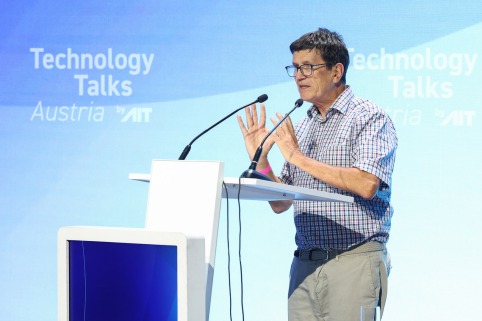
Dominique Foray (EPFL/SWR)
© Valerie Maltseva
In his first argument, Dominique Foray described Switzerland as a system built on two pillars. The first pillar is the adoption of new technologies across the whole country, underpinned by dual vocational education and training, the universities of applied sciences – not second-class universities, but institutions with profiles of their own, staffed by professors from industry – and innovation intermediaries that speak the same language as SMEs. SMEs are thus not, as Foray put it, ‘home alone’, but deeply integrated into a rich ecosystem.
The second pillar consists of excellent, research-intensive universities that generate knowledge and talent. Europe has only four universities among the world’s top 35 – ETH Zurich, TUM, LMU Munich and EPFL. In Switzerland, almost 90 per cent of public research funding flows to universities (in Austria 60, in Germany and France around 50 per cent). Public research organisations are no substitute for excellent research universities, not least because, as he observed, RTOs are not global talent magnets, whereas excellent universities most certainly are. We, too, must discuss this balance openly, because in the international competition for the best minds, the currency is ‘excellence’.
Foray’s second argument was devoted to structural change, which concerns me particularly: transformation and radical innovation entail creative destruction, and its costs, measured in monthly salaries, depend on labour market regulation – 2.5 months in Switzerland and Denmark, but 31 in Germany and the Netherlands, 38 in France, 52 in Italy, 62 in Spain. Countries such as Switzerland and Denmark pursue the strategy of flexicurity, that is, flexibility plus a serious effort to rebuild human capital: retraining, coaching, networks. Where these costs are low, the incentives to invest in disruptive sectors increase. Transformation into new technology fields can only succeed with social accompaniment – precisely what we, too, keep calling for at FORWIT. In this country, we speak of fair transition, an equally comprehensive concept.
Incidentally, it was no coincidence that flexicurity was also the most frequently mentioned word in the live poll asking which of the topics discussed on the panel the audience considered most important.
Austria: The innovation paradox and an economic structure with a built-in disadvantage

Theresia Vogel (FORWIT)
© Valerie Maltseva
Austria can be proud of its R&D ratio; the input is right and knowledge production is excellent. Our problem lies on the path from research to market, in output. This innovation paradox is rooted in a series of systemic deficits, notably a lack of product-market fit, low speed to product and a lack of sustainability in financing. A not insignificant role in this mix is played by our economic structure. While all the countries represented on this panel have an SME share of well over 99 per cent, unlike Austria they also have very large, globally active companies. This can be clearly captured in figures: market capitalisation amounts to around $2.4 trillion in Switzerland, $2.2 trillion in the Netherlands and $1.4 trillion in Sweden. Austria trails far behind with around $226 billion. What we lack are the large, globally active companies that pull SMEs along into R&D.
Why this is relevant was illustrated by Dominique Foray elsewhere: what is decisive, according to him, is not the relative research ratio – for when GDP is small, even 4 per cent is not enough to provide the infrastructural scale required for excellent research. What matters, rather, is the size of the sectors capable of absorbing spillovers. Novartis and Roche, as Foray noted, turn small Basel into a place of enormous international appeal. And I would like to add: large companies are also door-openers into the European research programmes, because without them it is almost impossible for SMEs to take part. With them, the SMEs come along.
Europe: An ‘Airbus of R&D’ instead of 27 parallel efforts
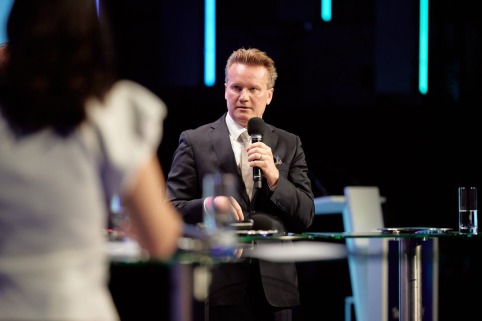
Georg Knill (IV)
© Valerie Maltseva
Georg Knill sketched the European dimension in realistic terms: we do too many things 27 times over in parallel – regulation, funding, strategies. He regarded completion of the single market (including the capital markets union) as a precondition for the EU27 to work together effectively and more closely. His image of a force-bundling ‘Airbus of R&D’, drawn using the example of a potential European goal of bringing the first commercially available quantum computer to market by 2030, I find very motivating. At the same time, he called to mind what such ventures often fail on: national location interests. These must be overcome, Knill said, urging us to think outside the box and to act faster, particularly in R&D policy. Malin Frenning added that every country must ask itself what strengths it brings to Europe – and that European funding must reward cross-border cooperation and shared infrastructures far more clearly in order to build European value chains.
Closing message: Excellence and tempo
To close, we each named our most important step for the coming year. For me, everything comes down to one word: excellence. Europe must attract the best minds worldwide – with excellent jobs, with freedom of science and with pride in what we have to offer here. For without excellent people, we will not bring new products to market. I was delighted by the others’ answers: Annelieke van der Giessen urged us to take along the people who carry the change; Dominique Foray reminded us that GDP per capita does not reflect our European standard of living and that productivity is the better yardstick; Malin Frenning called for data, technology and people to be thought of as one overall system; and Georg Knill distilled it into the formula that shaped both days of the Technology Talks: tempo. We have long known what needs to be done. Now we must implement it with the necessary speed and the requisite determination.