Blog
Focus, governance, transfer: Guiding principles of the RTI Pact 2027-29
6 March 2026


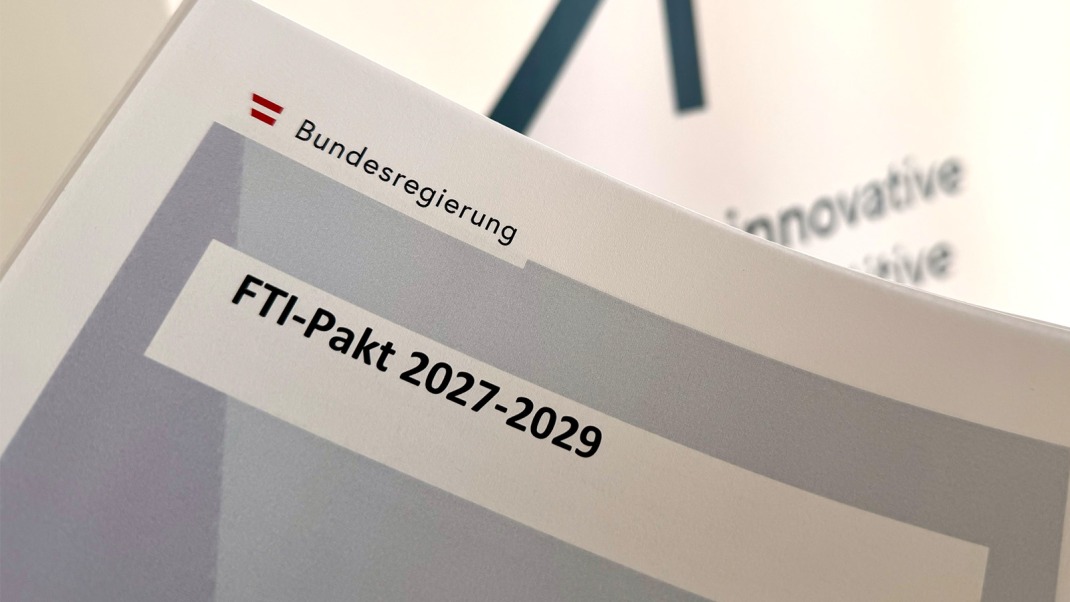
With the RTI Pact 2027-2029, adopted by the Council of Ministers on 24 February 2026, Austria is redefining the strategic and financial framework for research, technology and innovation for the next three years. The new RTI Pact not only continues the previous one but also marks a clear shift in emphasis: while the RTI Pact 2024–2026 was largely understood as a crisis and resilience framework, the 2027-2029 period places greater focus on geopolitically shaped competitiveness – coupled with the pursuit of technological sovereignty, a clearly visible focus on key technologies, and close alignment with the Industrial Strategy 2035.
Balance in the policy mix
The budget history illustrates why the RTI Pact is seen in stakeholder discussions as both a signal of stability and a trigger for debate. Originally, the Federal Medium-Term Financial Framework (BFRG) 2025 earmarked around €5.24 billion for the RTI Pact. In view of a tightening fiscal situation, this amount was reduced by approximately €197 million by the Subsidies Task Force (BMF). At the same time, reallocations in favour of basic research within the RTI Pact – amounting to around €450 million – resulted in an overall budget of around €5.5 billion. This corresponds to a nominal increase of roughly 5% compared with the figure in the BFRG (or around 10% compared with the RTI Pact 2024–2026, which originally stood at €5.05 billion).
From a macroeconomic perspective, however, this nominal increase is relatively small: according to WIFO expert estimates, it represents a real growth of less than 1% per year, as inflation and, in particular, rising personnel costs at relevant institutions are expected to absorb much of the nominal gain. In addition, an earmarking towards the Industrial Strategy shapes the allocation of funds: a total of about €2.6 billion is assigned here (BMFWF €900 million, BMWET €717 million, BMIMI €1.042 billion). By ministry, roughly €3 billion fall under BMFWF, around €1.7 billion under BMIMI and €728 million under BMWET – with BMIMI and BMWET being more strongly oriented towards applied research.
This constellation helps to explain part of the public debate about the balance in the policy mix: greater weight for basic research, while at the same time growing pressure to strengthen visibility in application-oriented dynamics and transfer performance.
Focus on key technologies
The shift in priorities is not merely semantic but structural. The RTI Pact 2027–2029 makes the key technology initiative its overarching theme and operationalises it through more explicitly defined technology domains and areas of strength. This sharpens expectations of the system to accelerate innovation pathways specifically where international competition, strategic dependencies and scaling potential are particularly high. This approach is attractive from a steering perspective, but it also entails the classic policy trade-off: the stronger the focus, the greater the need to justify how breadth and openness – particularly in curiosity-driven basic research – remain safeguarded as a pipeline for future key technologies.
Sharpened governance, stronger transfer
Governance logic is also new or significantly refined. The Pact 2027–2029 emphasises steering capacity through indicator-based monitoring, output and milestone logics, portfolio streamlining, and systematic simplification and digitalisation – including the once-only principle for research information and no-stop-shop approaches in procedures and interfaces. This represents a clear invitation to ministries, funding agencies and downstream institutions to design processes less granularly, more data-driven, and smoother for applicants. The benefits are obvious: lower transaction costs, faster decision-making, and greater transparency regarding effectiveness and target achievement.
However, the downside is equally clear: without harmonised data standards, legal clarity (on data use, proof logic, liabilities) and compatible IT architectures, simplification risks ending up in isolated solutions – shifting rather than reducing coordination workload.
The transfer mandate is also brought much more to the fore. The Pact addresses the input–output gap more explicitly and links it to an end-to-end instrument logic across the innovation cycle: from prototypes and demonstrators to pilot systems, scale-up and roll-out. This is flanked by the idea of systematically bridging TRL barriers and developing new instruments where gaps exist in the current portfolio. In practice, this means that funding agencies, universities and non-university research and technology organisations (RTOs – application-oriented institutions often functioning as bridges between science and the market) will be even more strongly oriented towards implementation capacity, cooperation with industry, testbeds and scaling. This represents a deliberate strategic choice: impact is expected to result not only from excellence in knowledge creation, but more visibly from speed and diffusion into value creation.
European connectivity, research security and dual use
Two cross-cutting themes also gain prominence. First, European connectivity: the RTI Pact prepares more explicitly for the logic of the EU funding period from 2028 onwards and strengthens the linkage between national frameworks and EU programmes – including options to nationally top-up excellent but unfunded EU projects. Second, research security and dual-use considerations are embedded more firmly as cross-sectional issues. This raises requirements for risk management and awareness structures and may entail additional compliance efforts, but simultaneously improves alignment with EU and international security standards and mitigates strategic blind spots in sensitive technologies.
Ultimately, the question is less whether the Pact is well designed, but how it will be implemented. The RTI Pact 2027–2029 more clearly aligns guiding principles with focus, steering capacity and transfer effectiveness, while integrating European and security policy dimensions more firmly into the system. Whether this translates into real gains in speed, reduced friction and visible impact will depend on three factors: the consistent harmonisation of data and processes (with once-only applied in practice, not just rhetorically), portfolio discipline (less fragmentation, clear gap logic) and the ability to strengthen transfer and scaling so that the debate on the balance between basic and applied research evolves into demonstrable improvement in the overall performance of Austria’s RTI system.

