Blog
Innovation activity declines as digital transformation progresses
16 December 2025


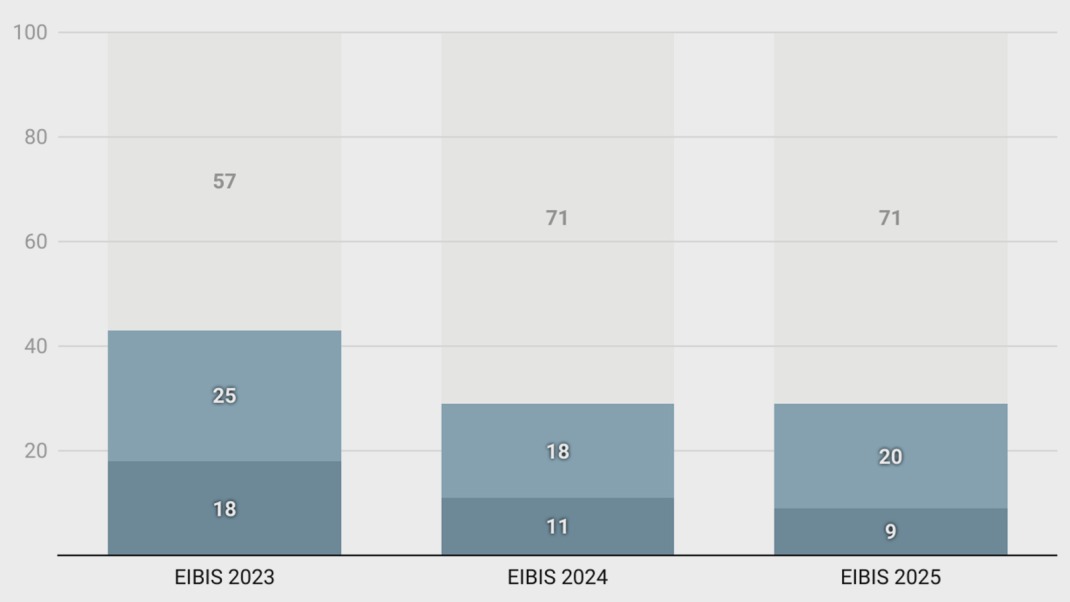
Last week, the European Investment Bank (EIB) published its 2025 Investment Survey, which analyses corporate investment and identifies challenges such as digitalisation, trade and the adoption of innovative technologies. Similar to the STI Monitor, the EIB study also shows that the share of firms introducing new products and processes in their market or worldwide has been declining continuously.
In the STI Monitor, the indicator “Innovative enterprises” provides a basic breakdown by innovation status. It covers both product innovations and new or significantly improved process innovations. In addition, it takes into account, among other things, completed innovation activities, ongoing innovation projects and innovation activities abandoned shortly before implementation. The values of this indicator are based on Eurostat’s Community Innovation Survey (CIS). In the most recent CIS data collection to date (2022), Austria, with 56.7 per cent innovative enterprises, was only slightly below the average of the innovation leaders. However, the time series in the RTI Monitor points to a downward trend, which is also confirmed by the current EIB Investment Survey: it shows that investment by Austrian firms in innovation activities is declining. Firms developing or introducing innovative products stood at 43 per cent in 2023, with this share falling to 29 per cent in both 2024 and 2025.

On the other hand, it is worth highlighting that the implementation of digital technologies in Austrian companies is continuously increasing. While the share of digital technology usage stood at 82 per cent in 2023, it rose to 87 per cent by 2025. A distinction is made here between the use of a single technology (e.g. IoT sensors for machine condition monitoring) and the deployment of multiple technologies (e.g. IoT in combination with big data and AI).
It is particularly striking that Austrian companies, especially in the manufacturing sector, are increasingly opting for the use of multiple digital technologies. The use of AI is also on the rise; Austrian firms primarily deploy individual AI tools for internal processes in the fields of sales, marketing, and customer serviceConsequently, Austria ranks significantly above the EU average.
This trend is also reflected in the Artificial Intelligence section of the STI Monitor. The evaluation of indicators in the STI Monitor suggests that the use of AI is currently still limited to individual business areas and does not occur across departments. Accordingly, there has so far been a lack of strategic, company-wide integration of AI across departmental boundaries.

