Blog
Technology transfer: Where productivity report and industrial strategy meet – and where they don’t
30 January 2026

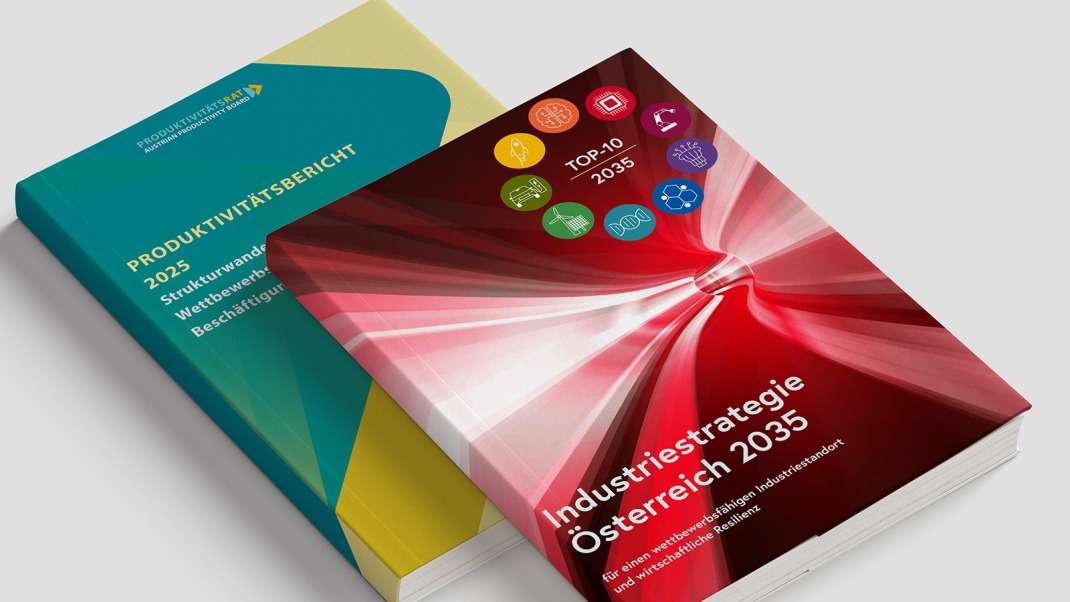
The Productivity Report 2025 and the Industrial Strategy Austria 2035 are strongly congruent in their fundamental diagnosis and objectives regarding technology and knowledge transfer: both describe a structural transfer gap. Austria invests a great deal in research and development, but in international comparison achieves too little market-effective innovation, productivity growth and industrial scaling from this. The Productivity Report identifies this weakness as a deficit in technology diffusion and economic exploitation despite high R&D expenditure. This is also evidenced by the indicators in the STI Monitor 2025. The Industrial Strategy takes up this connection by explicitly linking competitiveness and industrial success to the faster transfer of research into economic application.
Transfer is not understood here as an isolated measure, but as a systemic architectural question. The Productivity Report calls for strategic priority-setting on key technologies, the bundling of scientific and industrial competences in clusters, and continuous, flexibly combinable instruments along the entire innovation process. The Industrial Strategy pursues the same ambition from a more implementation-oriented perspective: it relies on a key technology offensive, on market-oriented research and demonstration projects, qualification networks and the expansion of application-oriented infrastructure in order to structurally accelerate transfer to the market.
A further clear area of commonality is the logic that transfer must be organised via ‘last-mile’ mechanisms, that is, via instruments that not only enable research, but systematically support scaling and market launch. The Productivity Report argues here for continuous funding approaches and milestone or stage-gate logics that work along the innovation process and should remain combinable between institutions. The Industrial Strategy adopts this approach in the form of concrete programme logics – for example, where stage-gate financing is mentioned as a funding principle and demonstration/piloting are positioned as market accelerators. There is also agreement on the role of established bridge programmes between science and business: the Productivity Report advocates strengthening the Christian Doppler Research Association (CDG) and the Competence Centres for Excellent Technologies (COMET), particularly through longer-term financing guarantees and thus greater planning reliability for transfer capacities. The Industrial Strategy explicitly highlights these programmes as an innovation pipeline and as instruments for exploitation and scaling.
Despite this high degree of congruence, differences can be identified that are relevant for the governance of implementation. The Productivity Report emphatically stresses technology openness and flexibility, because innovation and technology dynamics change rapidly and are inevitably unpredictable; consequently, an adaptable instrument system is needed. The Industrial Strategy, on the other hand, places greater emphasis on predefined key technologies and an extensive architecture of measures. This does not result in a contradiction, but does create a tension between strategic focus and the demand for adaptability. A second tension lies between the desire for unbureaucratic combinability of instruments and the risk of increasing system complexity: the Productivity Report expressly calls for funding instruments to be combined unbureaucratically across FWF, FFG and aws. At the same time, the Industrial Strategy establishes a broad governance and programme system. It is precisely here in the implementation that it will be decided whether acceleration is actually achieved or whether additional coordination burden arises.

