Blog
The Austrian higher education system
13 January 2026

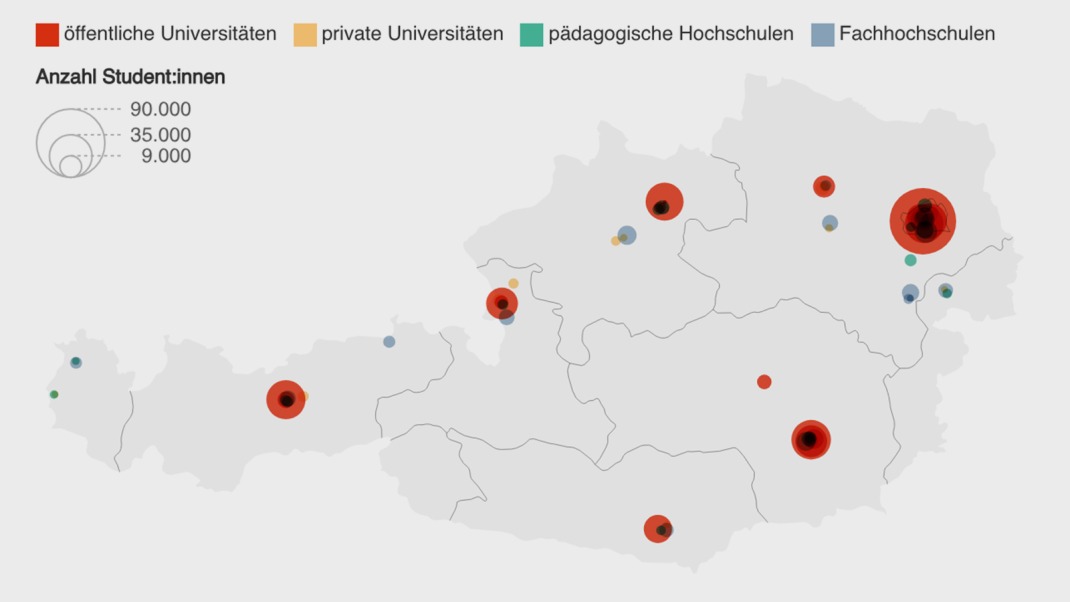
Higher education institutions form, in a sense, the organisational framework of the higher education system. In order to gain a comprehensive overview of this system for the analysis currently being developed, we have compiled all 77 institutions in Austria, provided them with key data (date of establishment, location, number of students) and coded them according to sector affiliation. The graphic allows for a closer examination of each institution and its location within the Austrian federal territory (for institutions with multiple sites, the official headquarters is used in each case).
Unsurprisingly, most higher education institutions in each sector are concentrated in Austria’s urban centres. Nevertheless, the density of institutions in and around Vienna is particularly striking. Several institutions from different sectors are also located in Graz, Linz, Salzburg and Innsbruck. In contrast, it is primarily institutions from the universities of applied sciences and private universities sectors that are distributed across wider geographical areas.
The representation of higher education institutions on a timeline from 1955 onwards (the year in which the Higher Education Organisation Act brought consolidated legal standards into force for the first time in the Second Republic) shows that the number of higher education institutions has grown significantly over the past 20 years. In addition to a series of new foundations—particularly amongst private universities—spin-offs and retitling have also contributed to this development. As part of the university reform, the medical faculties were newly established as three independent universities. Furthermore, existing institutions were formally designated as higher education institutions: this applied both to the universities of education (known as pedagogical academies until 2005) and to the universities of the arts (known as art colleges until 2002). Among the universities of applied sciences, the FH Military Sciences is an institution that was actually founded at the end of the 18th century, was long known as the “National Defence Academy” and was formally redesignated as a higher education institution a few years ago.
The following tabular representation is particularly interesting with regard to the differences in size between individual institutions. A key indicator in this respect is the number of students. The comparison makes it clear that institutions in the private universities sector, as well as those in the universities of education sector, remain relatively small. A certain degree of homogeneity in size (by student numbers) is also ensured amongst the universities of applied sciences. The range amongst public universities presents a different picture. The University of Vienna, with 85,000 students, is almost three times as large as the University of Graz, which as the next largest institution has just under 30,000 students. At the other end of the spectrum, half of the remaining public universities have 5,000 students or fewer.

