Budgets are only part of the equation: What kind of higher education does Austria need?

The widely reported budget cuts for Austria’s 23 public universities during the 2028–2030 performance agreement period have sparked public outcry. The debate, however, has focused solely on a battle over resource allocation—unintentionally underscoring the urgent need for a long-term higher education strategy. Otherwise, the critical question risks being overlooked: What kind of universities does Austria need?
Funding is only part of the equation: Enhancing the performance of higher education
“Funding is only part of the equation; what also matters is how precisely public funds are deployed.”
Thomas Henzinger
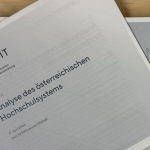
Austria boasts strong scientific research and trains highly skilled professionals. A federal government cannot afford to deprioritise research and science. As FORWIT Chair Thomas Henzinger emphasises, universities make a vital contribution to democratic understanding, social cohesion, prosperity, and national competitiveness. “Funding is only part of the equation; what also matters is how precisely public funds are deployed. As our recent analysis shows, Austria’s higher education system is not as effective as those in comparable countries. Simply maintaining current budget levels will do little to change this.”
Structural deficits: Study regulations, fragmentation, budget distribution, and career paths
Austria’s higher education system exhibits several peculiarities that serve no clear purpose and disadvantage everyone. These include:
- Study regulations at universities that, uniquely in international comparison, lack binding commitments, negatively affecting both social equity and graduation rates.
- A funding logic that not only cross-subsidises other policy areas (e.g., the healthcare system) but also assumes that state-provided budgets should be distributed in fixed proportions to institutions, regardless of performance.
- Fragmentation, where competition between higher education sectors is emphasised over their shared responsibility to the republic.
- An incentive system that funds international students at taxpayers’ expense, only to subsequently exclude them from the domestic labour market.
- Career structures for researchers that entrench precarity and hierarchies, rather than rewarding scientific achievements in the global competition.
“Business as usual” is not an option: A future-proof higher education strategy is urgently needed
“Nothing would be more dangerous than allowing higher education to fall into neglect through political inaction, as seen elsewhere.”
Theresia Vogel
“The federal government has set itself a sensible goal: to prepare Austria’s entire higher education system to meet current and future challenges. Nothing would be more dangerous than allowing higher education to fall into neglect through political inaction, as seen elsewhere,” warns Deputy Chair Theresia Vogel. The planned higher education strategy must therefore remain a top priority. A “business as usual” approach, as some advocate, will not address the immense demographic, technological, and geopolitical challenges ahead.
The FORWIT analysis outlines clear courses of action. Particularly in times of financial constraint, FORWIT cautions against discussing university budgets without simultaneously advancing fundamental systemic reform. The higher education system encompasses more than just public universities. The Republic—especially the Federal Ministry of Education, Science and Research (BMWF) and the representatives of all affected institutions—bears the responsibility of implementing a forward-looking higher education strategy that enhances the overall performance of Austrian universities in teaching, research, and knowledge transfer.