Three shortcomings are holding back Austria’s innovation transfer

Austria invests heavily in research, but economic exploitation has so far lagged behind. A new analysis by the Council for Sciences, Innovation and Technology (FORWIT) now clearly shows what is slowing down successful innovation transfer in practice – and what needs to be done so that the Federal Government’s recently presented industrial strategy is reinforced in its impact through a smart innovation policy.

“We need to remedy the systemic shortcomings in the transfer process from research, through application, into the market and its impact.”
Georg Kopetz

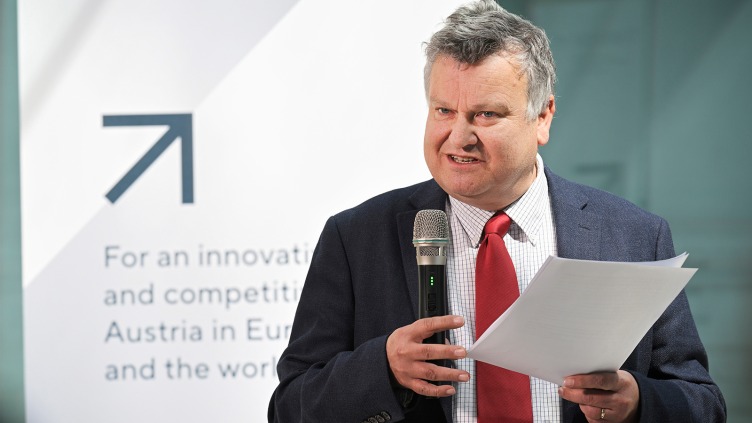
“We on the Council have been working intensively for some time on the question of how we can once again increase Austria’s competitiveness. Research and innovation are the keys to getting Austrian industry back to the forefront. However, this will only succeed if we remedy the systemic shortcomings in the transfer process from research, through application, into the market and its impact,” urges Council member Georg Kopetz.

Three key shortcomings: market needs, speed and sustainability

The analysis “From Science to Business: Speed, Market Impact and Sustainability” identifies the causes of Austria’s transfer gap in three critical dimensions:

  • Lack of product–market fit: Technologically excellent developments miss real market needs because market requirements are integrated too late into the innovation process.
  • Low speed-to-product: Funding, governance and decision-making cycles are not synchronised with global technology and market cycles. As a result, Austria loses pace in international competition.
  • Lack of sustainability in financing and technology pathways: In particular during the transition to high technology readiness levels (TRLs), scaling and market entry, reliable financing (patient equity) is lacking.

From diagnosis to implementation

“Our analysis now provides such an operational implementation logic for innovations.”
Georg Kopetz

The FORWIT analysis closes a crucial gap: while the 2025 Productivity Report provides the macro diagnosis – Austria’s weakness lies less in research excellence than in technology diffusion and economic exploitation – and the industrial strategy is intended to provide the political and implementation-oriented framework for transfer into industrial application, what had been missing until now was an empirically grounded operational logic for implementation.

“Our analysis now provides such an operational implementation logic for innovations and for what the Productivity Report and industrial strategy demand in political terms. The new industrial strategy will be particularly successful if the shortcomings in the transfer of research results into successful products are systematically and swiftly reduced,” emphasises Council member Georg Kopetz.

“Let’s build the future instead of defending the past”

Transcript of the speech by Deputy Chair Sylvia Schwaag Serger at FORWIT’s New Year Reception on 26 January 2026.
Supporting slides [PDF]

It is a somewhat sad evening for me. Ten years ago I received a phone call – I was in Beijing at the time – asking whether I would be interested in joining the Austrian Council for Research and Technology Development. I must be quite honest: I said yes because I had been missing the German language. Over the past ten years, however, I have truly come to know and love Austria, and it will be difficult for me to leave the Council. But I will remain connected to Austria. Since this is therefore the last time I shall be addressing you in this context, I should like to broaden the focus of my speech somewhat.

Technology, Geopolitics and the Future

I should like to begin with a book I rediscovered over Christmas whilst trying to understand this world: When Trust Breaks Down from 1990. I first read it when I was studying International Relations in Bologna. One quotation struck me as particularly important then, and even more so today: “Adherence to commitments promotes harmony between states. The inclination to disregard does not. A world without honour is a world without order. To keep peace, allies would be advised to keep promises.”

The events of the past two weeks – and by that I mean the Greenland episode, which we shall hopefully describe as such in history – have shown us with utmost clarity: the world is different from a year ago. It is a world in which the Nobel Prize has become purchasable, in which eighty-year-old alliances are being undermined and the international rules-based world order is being replaced by the law of the strongest. These past two weeks have also shown us how closely economics, geopolitics, technology and security are interwoven – and how they can be played off against one another.

“When Xi Jinping speaks about the world changing fundamentally, he speaks with confidence. And we often speak with concern.”

We are in a new world order. A year ago, in October 2024, we delivered the Heitor Report; at the same time came the Draghi Report. Much has happened since then. We have seen three military parades: China, USA, Russia. And I believe I need not tell you which was by far the most impressive – the Chinese one. However, I should also like to recall a statement by Xi Jinping from 2018: “From the mechanisation of the first industrial revolution in the 18th century to the electrification of the second industrial revolution to the informatisation of the third industrial revolution – rounds of disruptive innovation have fundamentally changed the development trajectory of human history.”

What I find interesting about this quotation: we know that technological disruption will fundamentally change our lives, and whether that becomes positive or negative lies with us. But when Xi Jinping speaks about the world changing fundamentally, he speaks with confidence. And we often speak with concern.

Technology as Driver of Change

“Our geopolitical problems are rooted in technological disruption.”

This change in world order is driven by geopolitics, by the decline of democracy – which Federal Minister Holzleitner also mentioned earlier – by climate change and the Anthropocene. But above all, I would say, by technology. At a high-level event in Stockholm recently, someone said: “It is such an unfortunate coincidence that these geopolitical problems are happening simultaneously with this technological disruption.” I would argue: our geopolitical problems are rooted in technological disruption. And we must understand that.

In his article in the New York Times a few weeks ago, Thomas Friedman expressed this very well when he spoke of the “Polycene” – in reference to the Anthropocene – and said: “Science, technology, and politics are interacting in a way and at a pace not seen before.” That, I believe, is in one sentence the fundamental challenge for our democracies.

The transformation researcher Jan Rotmans quite rightly said: “It’s not an era of change, it’s a change of eras.” And technology is driving these changes. At the same time, technology does not emerge in a vacuum. To quote Bruno Latour, a well-known sociologist: “Technology is society made durable.” Last year’s Nobel Prize winner, Daron Acemoglu, and his colleagues also argue in the same direction when they say that it is our task to frame technology – we are responsible for whether technology brings us benefit or harm and whether it builds the society we want.

The source of new technologies is science, and scientific fundamental principles are global – this applies particularly to the natural sciences, for the social sciences have never been as global as the natural sciences. But politics is becoming increasingly nationalistic. How we deal with this field of tension is one of my research areas. The return of security threats and war in Europe is a sign and a consequence of the new times we are dealing with.

In our Heitor Report we wrote: when we talk about competitiveness, we often talk about the competitiveness of our economy. But I would say it is about much more. It is about the competitiveness of our systems. We are in a strategic competition where it is about the power of ideas, the power of narrative, persuasiveness and mobilisation power.

I see this at my Academy. We receive one Chinese delegation after another trying to convince us that China is the stable major power, the responsible major power. And that it is time for us all to recognise this and fit into this new world system. That is what I mean by strategic competition.

When I ask the CEOs of leading Swedish companies what concerns them, they tell me, “the USA – that is a bit irritating, a bit unpredictable, a bit unstable. But our big problem is China. If we do not know how to deal with China, we will no longer be an industrialised country in ten years.” Europe must realise: China has caught up with the lead of European countries at great speed.

What Makes China Successful?

What is China doing right? When China sets priorities, it mobilises not just the entire government, but the entire country. When we – now I am talking about Sweden, then it will not be so personal – when we set priorities, it is not the mobilisation of the whole country. It is not thousands of levers that are set in motion to make this prioritisation a reality.

“China identifies and reduces dependencies whilst simultaneously strengthening its own indispensability.”

For ten years, at the latest since the “Made in China 2025” strategy, but also earlier, China has been doing the following quite deliberately: identifying and reducing dependencies, and simultaneously strengthening its own indispensability. I believe that is something we must also focus on more. In what are we indispensable in Europe, and how can we make ourselves even more indispensable?

Then there is leapfrogging. When I was in China for the first time twenty years ago, people were already saying: “Yes, we know we cannot catch up with the combustion engine, for example; Europe and the USA are ahead of us there. Therefore we ask ourselves: what is the next technological frontier and where does it lie?” I believe we should have the confidence to do that as well.

The last point: I have met many Chinese ministers, and one always thinks one must be extremely polite. I always expressed how impressive China was. But what really impressed me was the response. “We do not need this small talk. Tell us what we can do better.” In Europe, that does not happen to me so often.

What Does This Mean for Europe?

The Key Technologies Initiative is fantastic, but very many countries have identified the same technologies. That does not mean Austria should not do it – absolutely, Austria also has unique strengths. But we must always remember: with these new technologies, size matters. That is why we must work together with others.

In the Industrial R&D Investment Scoreboard 2025, the two thousand companies that invest the most in research and development are listed. Many from the EU are not amongst them, and the top four firms from the EU are in the automotive sector. There lies an enormous challenge before us. When we group the list by countries, Germany is leading in the EU, then comes France, then Sweden, and much further down follows Austria. I find that is quite an illuminating statistic.

What can Europe, what can we do? I have summarised it thus: Europe is overregulated and underpowered. We must invest together in our strengths and in the future (keyword: indispensability), promote technology application, “rediscover the magnificence of science”, embrace creative destruction, defend the rules-based world order, develop other markets (India, Mercosur, CPTPP, etc.) and realise the Single Market. Apropos magnificence of science, I recommend the article “The Counter-Reformation of science”.

“It is a problem that we always think we must invent everything ourselves.”

Focus much more on technology diffusion and application. It is a problem that we always think we must invent everything ourselves. Historically, one sees that this is not the case. The country that develops the technologies is not necessarily the country that profits from them. And of course the Single Market. “Europe is afraid of its own power,” said the Ukrainian ambassador at the annual security conference in Sweden – which I found very important and very correct.

I have spent the past two years, together with a few authors – Soete, Johan Flenner, Michael Landabaso – and based on contributions from a group of experts, writing a text: Capitalism, Sustainability and Democracy [forthcoming, Ed.] – in reference to Schumpeter’s Capitalism, Socialism and Democracy. We see Europe’s opportunity in the fact that Europe is the only region that can productively connect these three cornerstones of this triangle with one another.

The USA is currently abandoning sustainability and we do not know how its democracy stands. China has decided against democracy and is now very successfully pursuing capitalism, but also sustainability. Europe is, in my opinion, the only region where we can meaningfully connect these three cornerstones with one another. But at the moment they are undermining one another.

Austria

Austria has many things that others envy. I have been able to observe this over the past ten years. There are extremely many bright minds here and excellent research. It has such things as IST Austria or the Complexity Science Hub, which I envy Austria very much – I have been trying for years to establish something similar in Sweden. The STI Monitor, the RTI Pact, and this incredibly impressive development of the R&D ratio – that should also be mentioned again.

“Is it really an initiative for key technologies that is supported by the whole government – and not just the government, but all relevant actors?”

I find the Key Technologies Initiative extremely important. It is an important signal to show that one is prepared to set priorities. But I also ask myself: is the prioritisation effective? Here I refer again to what I said about China: is it really an initiative that is supported by the whole government – and not just the government, but relevant actors in research, business, society, who mobilise and pull together?

This was also mentioned: we have a new era. But are we developing new tools that enable us to deal with this new era? I would say no. We are still using the same tools. And that is a big problem.

On Monday we had a seminar which the Swedish Defence Minister was supposed to attend. Seven hundred people had registered. He had to cancel due to Greenland. But what I heard in conversations with people who work at the very top of the Swedish government – and what I also hear increasingly in other contexts: the Nordic countries increasingly have the feeling that they can only rely on their neighbours, that parts of Europe do not understand or acknowledge the existential security threat posed by Russia. And that worries me, because for ten years I have felt that Austria and the Nordic countries would benefit greatly from working together. But at the moment the impression is growing that the other countries, not least Austria, do not understand what we are dealing with and are not prepared to actively and concretely commit themselves to it. Perhaps the Nordic and Baltic countries are the only ones we can rely on. And that worries me for the cohesion and future of Europe.

Connecting Knowledge and Action

Joel Mokyr was one of the Nobel Prize winners we were able to welcome to our Academy and I had a fantastic experience interviewing him. Mokyr always speaks of propositional and prescriptive knowledge. I should like to give this to Austria as well: it is not enough to be good only in basic research. “You have to study things and you have to make things.” This connection is what distinguishes leading countries.

“How does creative destructive power stand in Austria?”

Then I would lean on the Nobel Prize winner Philippe Aghion, who spoke about Schumpeter’s creative destruction. And here I should like to ask the question whether Austria is perhaps a bit structurally conservative, that is, has conservative structures? And how does creative destructive power stand in Austria?

Apropos creative destruction, a warning from a former staff member in the Office for Science and Technology Policy under Obama and Biden is constantly present in my mind. He said: “I do not wish on anyone what we are now experiencing with our president. But I wish we had tackled some of our problems more seriously when we had the chance. We had real problems in the American research system, and by not addressing them, we lost credibility (in science but also in democracy).” That is something that also concerns me with regard to Europe: we must address our problems so as not to open the door to something similar to what is happening in the USA.

Dual Use and Futures Research

Here I wanted only to show: Vinnova, the Swedish innovation agency, together with the German SPRIN-D, has issued a call for proposals for dual-use anti-drone initiatives or tools. I find this collaboration between two innovation agencies from two countries on this topic extremely interesting and sensible. The Swedish Foundation for Strategic Research has something similar – to my knowledge the first official call for proposals for dual use.

At my Academy we have launched the initiative Swedish Futures. We must of course work in an evidence-based manner, but we must also imagine the future. As the first member state of the EU, we have therefore commissioned exactly the same technology analysis for Sweden that underlies the Draghi Report. The report had a great effect: suddenly quite different actors are talking about Sweden’s technological strengths and weaknesses than we are actually accustomed to.

Closing Words

I am at the end. What I take away: if we want to shape this future for ourselves, it is about self-confidence – in a double sense of the word: “know yourself” and “believe in yourself”. It is about imagination, and it is about capacity to act and willingness to act. Here I come back to Thomas Friedman, who said: “The most adaptive, resilient and productive communities in the polity will be those that can assemble complex adaptive coalitions.” We have launched such a complex, adaptive coalition in which we bring together the trade unions, the largest Swedish companies and all the other stakeholders to steer Sweden’s future in the right direction.

I have followed Austria’s catching-up race of recent years with great interest, great passion and great admiration. But I must simultaneously say: catching up is no longer enough. I believe we in Europe have the wrong frames of reference. In Austria one always wants to catch up to the Innovation Leaders. Who are the Innovation Leaders of the future? I do not believe that today’s European Innovation Leaders are necessarily the future global Innovation Leaders, if things continue as they are. We must therefore consider: whom and what should we orient ourselves by?

These are unique times. Joel Mokyr said: “Don’t think out of the box. Break the box.” I would take that with me, because otherwise we will not get anywhere. The other is a greater focus on results and less on processes.

“I would encourage the Austrians to believe more in themselves. Austria has incredibly much to offer Europe.”

In conclusion, I want to emphasise once more: it has been a tremendous honour to serve Austria. I did it because I believe in Europe and because Europe needs Austria. An appeal to Austria: believe more in yourselves. The Swedes have a healthy self-confidence, and that is important and positive, especially in times like these. It gives strength to act courageously. I would encourage the Austrians to believe more in themselves. Austria has incredibly much to offer Europe, and it is time for Austria to confidently take the step from follower to leader – with everything that entails.

I must be quite honest: I am more optimistic today than I was two weeks ago. The response that Europe has shown to the Greenland episode gives me confidence. Therefore I hope that we dare to build the future instead of defending the present and the past.

Thank you very much.

***

This is the transcript of a speech by Deputy Chair Sylvia Schwaag Serger at the opening of FORWIT’s New Year Reception 2026 on 26 January 2026 in the Austrian Parliament.

FORWIT urges swift adoption of outstanding RTI Pact

According to the Research Funding Act, the RTI Pact 2027-29, which operationally implements the RTI Strategy 2030, should have been adopted by the end of 2025. FORWIT considers the fact that the resolution is still outstanding to be a concerning signal. “Secure and reliable funding for research and innovation is a crucial factor for competitiveness, growth and prosperity for tomorrow. This lever, which is so essential for future viability, must therefore be treated with the necessary priority and endowed with the intended funding,” appeals Thomas Henzinger, Chair of the Federal Government’s advisory body.

Over the past two decades, Austria has undergone an impressive development in terms of research and innovation policy and now ranks amongst the innovation-strong countries of the European Union. However, Austria cannot rest on its laurels, Henzinger cautions. “In the current European Innovation Scoreboard, Austria lost two places; in the Global Innovation Index, we are back at the 2020 level; and in the World Competitiveness Index, Austria has lost 10 places in five years. It may be that our performance in research, technology and innovation is as good as it was five years ago. But other countries have improved during this time.”

From FORWIT’s perspective, given the many major challenges, there is a need for a sense of urgency for decisive and ambitious action. This includes, in particular, properly deploying the keys to the great challenges of our time—research and innovation. “Particularly in Austria’s economically and budgetarily challenging situation, the country needs a reliable, future-proof RTI policy,” says Henzinger.

New Year’s Reception 2026: Meeting with members of the government

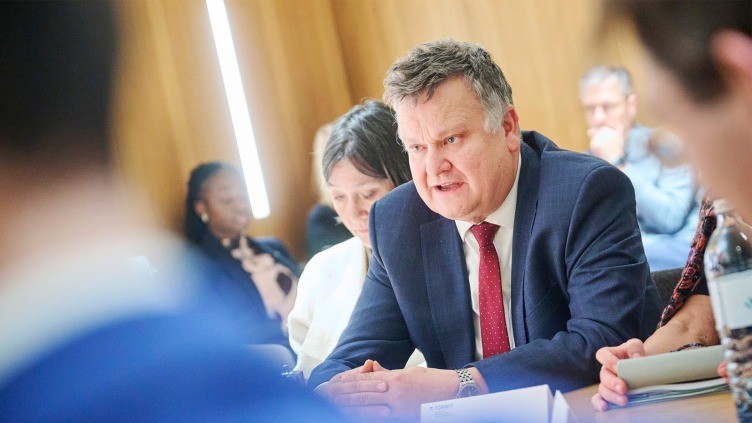
On the occasion of the ninth session of the Council, FORWIT’s traditional New Year’s reception took place on 26 January in the parliamentary premises. Beforehand, the members of the Council met together with the managing director for an informal exchange with Minister for Science and Research Holzleitner, Minister for Economic Affairs Hattmannsdorfer and State Secretary Zehetner.

Tom Henzinger, Chair of FORWIT, once again emphasised to the government members that a swift conclusion of the overdue RTI pact 2027-29 was urgent in order to establish financial security for the coming years. Federal Minister Hattmannsdorfer referred to the federal government’s industrial strategy published a week earlier and asked FORWIT to support the implementation of this significant government initiative. Minister Holzleitner explained that she wants the process for developing a higher education strategy 2040, which has now been launched, to be understood as a reform to make universities fit for the future. She thanked FORWIT for the work carried out thus far, together with the sounding board established for this purpose.

In the discussion, Henzinger emphasised the relevance of research and technology development in many of the federal government’s reform initiatives and offered FORWIT’s support. Among the council members, Georg Kopetz referred to the necessary framework conditions that are particularly relevant for the financing of deep tech companies. Helga Nowotny referred to Austria’s role in a technologically sovereign Europe. Finally, there was also discussion about how FORWIT could support the federal government with the initiative formulated in the government programme under the ‘research governance’.


New Year’s Reception 2026

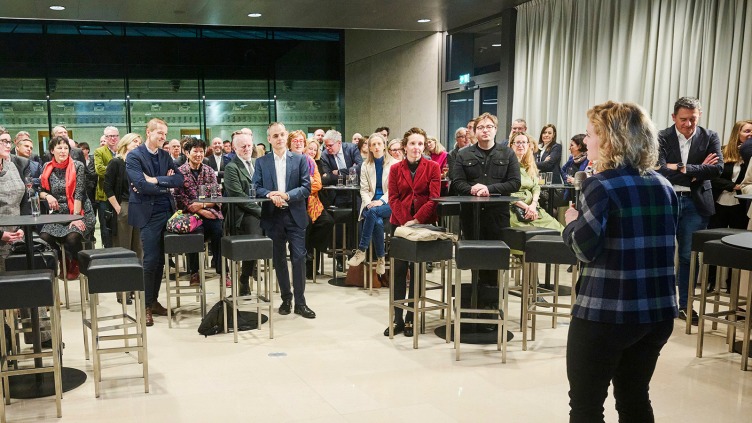
Around 100 representatives from politics and all areas of the Austrian STI system gathered at the subsequent New Year’s reception. The welcoming remarks from the government members were followed by a compelling speech by Sylvia Schwaag Serger. Schwaag Serger, who is stepping down from her mandate at FORWIT at the end of March after ten years’ work on Austrian advisory bodies, took a critical but nonetheless positive view of Austria’s role in the world. Finally, guests took the opportunity for networking and informal exchange.

The status quo of the higher education system analysis

This is a translation of the transcript of the presentation on the status quo of the analysis of the Austrian higher education system, on the occasion of the launch of the development process for the Higher Education Strategy 2040 by Federal Minister Eva-Maria Holzleitner on 3 December 2025 at the Aula der Wissenschaften in Vienna.

***

Minister, Ladies and Gentlemen, thank you for the opportunity to speak here today as Chairperson of the Council for Sciences, Technology, and Innovation regarding our contribution to the Higher Education Strategy 2040.

The Federal Government has requested that we undertake an analysis of the Austrian higher education system—effectively an assessment of the status quo—to serve as a foundation for developing the Higher Education Strategy 2040. I am very pleased to follow the previous speakers—Minister Holzleitner and Lisz Hirn—who both made it clear how vital universities are to a modern society.

“Higher education institutions are essential for the innovative strength and economy of our country.”
Thomas Henzinger

Earlier, during an interview, I was asked whether universities will still be needed in the year 2040. Of course, it was a rhetorical question, but we should answer it nonetheless. Universities are important for at least two reasons. Firstly, as we have already heard, they are an indispensable component of a resilient democracy. We have spoken less about the second reason today, which is why I wish to explicitly emphasise it once more: higher education institutions are essential for the innovative strength and the economy of our country.

Excellent scientific education and innovative research are the guarantors of our prosperity. Our universities are Austria’s future. But what is the current state of the Austrian higher education system? From what starting point will it be transformed by the future Higher Education Strategy up to 2040? These are the questions guiding our contribution—the analysis of the higher education system. Together with the members of the FORWIT working group—Jörg Flecker, Theresia Vogel, and external expert Jürgen Janger (WIFO)—we began our work in September by establishing an initial overview.

What is immediately apparent is the complexity of the system. Universities fulfil many different roles in our society. If the system were a company, one would demand more focus. However, the diverse tasks of universities are all of significance and importance; we cannot simply scrap certain tasks in favour of others deemed more important.

“Our analysis follows the three classic, core missions: teaching, research, and the third mission.”
Thomas Henzinger

We have decided to organise our analysis along the three classic, core missions: teaching, research, and the third mission. In our analysis, we subdivide each of these three missions into two fields of impact for which they provide added value: one for Austrian society and one for the country’s economic innovative strength. To make the system’s performance at least approximately measurable and internationally comparable, we are examining potential quantitative indicators to help us robustly analyse each of these six impact areas.

The mission of teaching for our society is to enable tertiary education for as broad and diverse a segment of the population as possible. For the needs of our economy, and thus the labour market, it offers modern, high-quality initial and continuing education programmes.

The mission of research for society is to enable curiosity-driven research at the highest level and to contribute to the expansion of global knowledge. This is what is generally known in Austria as basic research. Regarding the economic impact area, universities address relevant questions from industry and society through their research.

And finally, the third mission, which has the broadest spectrum of all three tasks and for which one must select representative examples. We can certainly postulate that Austria’s universities act as cosmopolitan centres for evidence-based discourse at both regional and national levels. I believe this is a vital role for universities that we must not underestimate. The third mission is also of essential importance for our prosperity: Austria’s universities are the starting points for knowledge-based innovation and new entrepreneurial success.

These are the three missions of our universities and their six impact areas.

I believe it is clear that we have a solid higher education system that fulfils these tasks well in many areas and possesses significant strengths: free access to higher education, good vocational training, excellent researchers, diverse collaborations with industry, a continued high level of social prestige, and, of course, the clear commitment of the public sector to university funding.

“Can we assume that our current strengths will still be strengths in 15 years’ time?”
Thomas Henzinger

But is this enough for the university of 2040? Can we assume that our current strengths will still be strengths in 15 years, and that they will still help us to hold our own in international competition? I believe we must have significantly improved our universities by then; the university of 2040 cannot be the same as the university of the 20th century if it is to fulfil its core missions effectively. Therefore, I believe we must be clear about which challenges and weaknesses we need to address. Some have already been mentioned, but I would like to go into them explicitly once more.

At FORWIT, we see three major thematic areas where there is certainly room for improvement. I will outline them under the following titles: “Studying in Austria”, “What will the university of 2040 look like?” and “Funding and Autonomy”.

Studying in Austria. We consider this topic particularly important and established a working group roughly a year ago—long before there was any talk of a higher education analysis or strategy, or the current Federal Government.

If you speak with international academics about studying in Austria, you quickly realise how uniquely non-binding the organisational processes of studying are here by international standards. Nevertheless—or perhaps because of this—we speak of two clear challenges: the low higher education attainment rate and the low level of social diversity. I believe the objective in the 21st century must be to increase the attainment rate—the proportion of the population with a degree. This is a substantial contribution to a resilient democracy, to our innovative strength, and to tapping into the talent potential within the population. If you speak to experts, you will learn that labour market flexibility and equal opportunities increase with educational levels. We are not even discussing which degrees are more or less relevant, or what the industry’s demand for skilled workers is. The more education a person receives, the more capable of learning they become. And the ability to learn is a decisive—if not the only truly reliable—competence in today’s working world, where we do not know what job profiles will look like in ten or twenty years. The societal goal must be to have as many people as possible in the country who are capable of learning. This does not harm our democracy; on the contrary.

Therefore, I believe—even if some say it is too radical—that we should set a target for a higher education attainment rate of 50%. We are currently at just under half that. How can we effectively increase this rate? I believe there are two very important levers: studying must be predictable and affordable.

“I would highlight the problem of a lack of commitment, and from all sides: the students, the universities, and higher education policy.”
Thomas Henzinger

Both factors primarily affect those from less educated backgrounds and children from non-academic families. One thinks twice about studying if it is unclear when the degree can be completed and whether a part-time job is required. I would wish for every first-year student to have a bachelor’s degree after three years. I would highlight the problem of a lack of commitment here, from all sides: the students, the universities, and higher education policy.

What will the university of 2040 look like? No one has a crystal ball, but it is clear that we need a dynamic higher education system that responds to demographic, technological, and geopolitical shifts, and that continuously develops and changes. Demographic change is self-explanatory. Technological change is also clear: here we are talking, for example, about studies shifting further online and learning moving even more away from content towards competences. Why geopolitical? Generations of students from all over the world have moved to the USA. Now, those paths are being questioned. This presents an opportunity for Austria. As a country, we should consider how we want to handle this.

We need a higher education system with strong intrinsic innovative capacity, capable of reforming itself without the need for new foundations, of renewing itself independently, and of adapting to extrinsic processes of change. A system that thereby becomes internationally competitive and so attractive that the best minds choose Austria. To achieve this, we must also talk honestly about the deficits in traditional academic career paths, which are still largely anchored in the structures of the 20th-century university. They are also characterised by silos and almost non-existent vertical permeability.

Our goal should be to get young, competitive researchers into independent, secure positions quickly and at a relatively young age. In parallel, it would be sensible to establish further science-related career paths for roles in teaching, research infrastructure, science management, science communication, and technology transfer. These are all academic careers that do not have the traditional professorship or Principal Investigator role as their final destination.

“How can funding create an effective incentive system that links input and output?”
Thomas Henzinger

This brings me to the third and final field of challenge: funding, autonomy, and how these two aspects interact. I see here, firstly, the problem of an ineffective distribution apparatus—a phenomenon we also observe in other areas of the Austrian research, technology, and innovation system: output is not directly linked to input. How can funding create an effective incentive system that links input and output, rewards performance, and plans and manages with cost-truth based on actual figures?

Secondly, the institutional branding of universities is a key success factor. You all know Stanford, Harvard, or Oxford. The institution is the brand used to recruit students on the global market. It is not the consortium of institutions, and it is not the small sub-department. All of that dilutes the brand, and this is hardly understood in Austria. If we want to have over 70 higher education institutions in Austria, they must all be distinguishable from one another—including internationally. They should all form their own brand and be attractive to a specific group of students.

In addition to the core missions of teaching and research, it is important for branding—and beyond—to pay attention to the interfaces of universities. Universities do not exist in isolation; they are a vibrant part of society. We are speaking here of the interface between schools and universities, the interface between universities and non-university research, and the interface between universities and industry. But also the interfaces with administration and politics, regions and society, and finally the international interface with Europe and beyond.

In closing, I would like to give you a brief insight into our analysis process and an outlook for the future. A systemic analysis gains robustness when an independent external perspective and learning from the experiences of other countries are included. To incorporate this important aspect, we have recruited four distinguished experts for an international Sounding Board: Rachel Brooks (Professor of Higher Education, University of Oxford), Lino Guzzella (former President of ETH Zurich), Ingvild Reymert (Higher Education and Research Policy Scientist, Oslo Metropolitan University), and Robert-Jan Smits (former President of TU Eindhoven and former Director-General for Research and Innovation at the European Commission). The Sounding Board will meet for the first time here in Vienna on 5 December. One of the first topics will be the discussion and identification of meaningful and representative indicators.

There will be two further working sessions with the Sounding Board, the third at the end of March. We hope to hand over our report to Minister Holzleitner and the Federal Government in early April.

Thank you for your attention.

First working meeting with the Sounding Board

The first meeting of the internal working group with the Sounding Board marks an important milestone in the analysis of the Austrian higher education system that FORWIT is currently conducting as one of the foundations for the development of the 2040 Higher Education Strategy. The exchange now launched will critically accompany this process and bring in an international perspective.

International experts providing an outside view

The aim is to systematically confront key findings on the performance, governance and funding of the Austrian higher education system with experiences from other countries. The Sounding Board brings together distinguished figures from higher education policy, university leadership and education research who know different national systems from their own experience. This mix is intended to ensure that Austria’s higher education system is not only compared in terms of key indicators, but also against institutional reform pathways and strategic choices in other countries. The members of the Sounding Board are:

  • Rachel Brooks (University of Oxford) is an expert in the analysis of international student mobility and the internationalisation and Europeanisation of higher education institutions.
  • Lino Guzzella was Rector of ETH Zurich from 2012 to 2014 and President from 2015 to 2018.
  • Ingvild Reymert (Oslo Metropolitan University) is a political scientist focusing on higher education and research policy, in particular the governance and organisation of public institutions.
  • Robert-Jan Smits was Director-General for Research and Innovation at the European Commission, where he played a leading role in shaping the EU research programmes Horizon 2020 and Horizon Europe. Until 2025 he was President of the Executive Board of Eindhoven University of Technology (TU Eindhoven).

“I am very pleased that we have been able to win these four outstanding experts to accompany and comment on our analysis from an international perspective,” says Henzinger.

First working meeting as a starting signal

At the first joint working meeting, members of the working group and the Sounding Board discussed the analytical framework, guiding questions and initial findings. The central issue was which international comparative perspectives are particularly relevant for Austria – ranging from study success and talent attraction to governance structures and the social responsibility of higher education institutions. As the process unfolds, the Sounding Board will act as a sounding board for interim results and as a sparring partner for key propositions of the analysis. The assessments will feed into the stocktaking exercise that will provide the basis for further development of the 2040 Higher Education Strategy.

About the analysis of the Austrian higher education system

On the basis of its government programme, the Austrian Federal Government has commissioned FORWIT to carry out an analysis of the higher education system, which is to serve as one of the foundations for the preparation of the 2040 Higher Education Strategy. The task of this analysis is to describe the Austrian higher education system in its current state and to assess its systemic performance. To this end, quantitative indicators are being defined, possible target dimensions for the three core tasks of higher education institutions – knowledge transmission, knowledge production and knowledge transfer – are being proposed, and potential challenges are being identified that require a policy response.

The analysis will provide a basis for the preparation of the higher education strategy, which must answer the question of what kind of higher education institutions Austria will need in 2040.

FORWIT analyses Austria’s higher education system

At the kick-off of the development process for the 2040 Higher Education Strategy with Federal Minister Eva-Maria Holzleitner last Wednesday, FORWIT Chair Thomas Henzinger presented the objectives and ambition of the ongoing analysis of the higher education system, which the Federal Government has commissioned the Council for Sciences, Technology, and Innovation (FORWIT) to carry out.

Higher education analysis by FORWIT as a basis for the 2040 Higher Education Strategy

“The task of this analysis is to depict the Austrian higher education system – we are talking here about more than 70 institutions – in its entirety as it currently stands and to determine its systemic performance capacity.”
Thomas Henzinger

“The task of this analysis is to depict the Austrian higher education system – we are talking here about more than 70 institutions – in its entirety as it currently stands and to determine its systemic performance capacity,” explains Thomas Henzinger, head of the Council’s internal working group. To this end, quantitative indicators are being defined, possible target dimensions for the three core tasks of higher education institutions – knowledge transmission, knowledge production and knowledge transfer – are being proposed, and potential challenges are being identified that require a policy response.

The analysis constitutes a robust and necessary basis for the preparation of the higher education strategy, which must answer the question of what kind of higher education institutions Austria will need in 2040, Henzinger explains. “Only if we know where we stand can we act in a targeted and forward-looking manner.”

Experts on the Sounding Board provide the international perspective

An independent external view and learning from the experiences of other countries are also essential. To ensure that this important aspect is duly reflected in its analysis, FORWIT has secured four distinguished experts for an international Sounding Board: Rachel Brooks (Professor of Higher Education, University of Oxford), Lino Guzzella (former Rector and President of ETH Zurich), Ingvild Reymert (higher education and research policy scholar, Oslo Metropolitan University) and Robert-Jan Smits (former President of Eindhoven University of Technology and former Director-General for Research and Innovation at the European Commission). The Sounding Board will convene for the first time on 5 December.

“I am very pleased that we have been able to win these four outstanding experts to accompany and comment on our analysis from an international perspective,” says Henzinger.

A future-proof society needs high-performing higher education institutions

“It is therefore essential that Austria’s higher education institutions will also in future be capable of delivering the services expected of them and that a future-proof society needs.”
Thomas Henzinger

For Austria’s future development, it is crucial to position higher education institutions as effective sites of knowledge transmission and production, but also of knowledge transfer. They operate as nodes of societal debate, entrepreneurial innovation and political decision-making, Henzinger stresses. “It is therefore essential that Austria’s higher education institutions will also in future be capable of delivering the services expected of them and that a future-proof society needs.”

FORWIT’s report on the analysis of the Austrian higher education system is scheduled to be submitted to Federal Minister Eva-Maria Holzleitner and published in April 2026.

Report on the 8th session and visit to Berlin

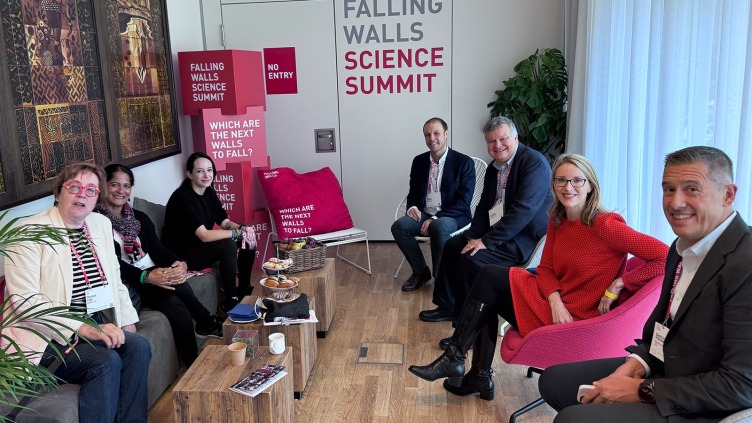
The 8th FORWIT Council session was held in conjunction with a special event in Berlin: the Falling Walls Science Summit, which takes place annually on 9 November to commemorate the fall of the Berlin Wall.

The Falling Walls Science Summit brings together top researchers, science managers, and representatives from politics and intermediary organisations. Participation offered the members of the FORWIT Council the opportunity to engage in numerous discussions with young and established, creative scientists, researchers, and entrepreneurs, and to strengthen FORWIT’s international network.

As part of the conference, two FORWIT side events were organised. An exchange on scientific policy advice took place with Alena Buyx, Professor of Ethics in Medicine and Health Technologies and Director of the Institute of History and Ethics of Medicine at the Technical University of Munich. There was also an opportunity to meet Tayebeh Saghaei and Francesca Kastner, the winners of this year’s Falling Walls Lab pitches in Austria.


On the day after the conference, 10 November, FORWIT had the opportunity to hold its Council meeting on the premises of the Austrian Embassy in Berlin. The two main topics of the meeting concerned the implementation of the 2026 work programme and a discussion of the research, technology and innovation policy initiatives anchored in the government programme.

The stay also provided an opportunity to exchange views with Irene Bertschek, the new Chair of the German Expert Commission on Research and Innovation (EFI), and Helge Dauchert, Head of its Secretariat. During a flying lunch, there was an in-depth dialogue about the working methods of advisory structures, as well as the thematic priorities pursued by the two councils. In particular, the discussions focused on how Austria and Germany might succeed in translating scientific research results more rapidly into technological developments and successful enterprises, and on which initiatives at European level should be jointly supported or pursued in order to help close the emerging technology gap between the EU’s research and economic area and other global regions.


Another highlight of the delegation’s visit was the FORWIT panel discussion on the theme “Rethinking Competitiveness: Capital Markets Union, Start-ups and the Role of Policy in Europe.” Elisabeth Riederer, Minister, welcomed around 100 guests to the event hall of the Austrian Embassy. The panel featured Georg Kopetz (FORWIT), Irene Bertschek (Chair of the EFI), Jano Costard (German Federal Agency for Disruptive Innovation, SPRIND), and Ron Melz (CEO of Spine Energy).

The panel discussion conveyed a clear message: Germany and Austria continue to play leading roles in key areas of scientific and technological development, yet international competition remains fierce, and the successful market launch of innovative products and the diffusion of new technologies into companies are progressing less effectively. In particular, limited access to private venture capital poses challenges, especially for young companies in their growth phase. A promising avenue for retaining investors in Europe while fostering growth and stability lies in the harmonisation of financial regulations and the creation of new financing instruments for green and digital investments within a common Capital Markets Union.

Einen weiteren Höhepunkt der Delegationsreise bildete die Podiumsdiskussion des FORWIT zum Thema „Wettbewerbsfähigkeit neu denken: Kapitalmarktunion, Start-ups und die Rolle der Politik in Europa“. Elisabeth Riederer (Gesandte) begrüßte rund 100 Gäste im Veranstaltungsraum der österreichischen Botschaft. Am Podium diskutierten Georg Kopetz (FORWIT), Irene Bertschek (EFI-Vorsitzende), Jano Costard (Deutsche Bundesagentur für Sprunginnovationen (SPRIND)) und Ron Melz (CEO von Spine Energy).

Der Tenor der Podiumsdiskussion war eindeutig: Deutschland und Österreich nehmen nach wie eine führende Rolle in wichtigen Bereichen wissenschaftlicher und technologischer Entwicklung ein, doch der internationale Wettbewerb ist intensiv und die erfolgreiche Markteinführung innovativer Produkte und die Diffusion neuer Technologien in die Unternehmen gelingt weniger gut. Insbesondere beim Zugang zu privatem Risikokapital bestehen Engpässe, die vor allem junge Unternehmen in der Wachstumsphase vor Probleme stellen. Eine Chance, Investor:innen in Europa zu halten und Wachstum und Stabilität zu erhalten, wird in der Harmonisierung von Finanzvorschriften und Schaffung neuer Finanzierungsinstrumente für grüne und digitale Investitionen, im Rahmen einer gemeinsamen Kapitalmarktunion gesehen.

Rethinking Competitiveness

Invitation to the Panel Discussion “Rethinking Competitiveness: Capital Markets Union, Start-ups and the Role of Policy in Europe” — an initiative by FORWIT and EFI, 10 November 2025, 13:00 at the Austrian Embassy, Berlin

Europe stands at a crossroads. In the global race for technological leadership, sustainable growth and economic resilience, the continent – and with it key economies such as Austria and Germany – risks falling increasingly behind. Geopolitical shifts, rapid technological progress and, not least, the ambitious trajectories pursued by other economic regions such as the United States or Asia are putting European competitiveness under mounting pressure.

To meet these challenges effectively, decisive and coordinated action is needed now. A future-proof Europe must draw on its strengths while at the same time initiating bold reforms. This includes, among other measures, the development of a deeper and more efficient Capital Markets Union, legal and regulatory frameworks that foster innovation, and closer synergies between public policy, innovative start-ups and established businesses.

  • How can capital markets be leveraged more effectively for growth and innovation?
  • Beyond the Start-up and Scale-up Strategy published this year, what further reforms are needed to make start-ups competitive within the European single market?
  • And what can – or must – policymakers do to reinforce Europe’s economic strength?

These and other questions will be at the heart of a joint event organised by FORWIT and Germany’s Expert Commission on Research and Innovation (EFI), bringing together representatives from business, the start-up ecosystem and policymaking to discuss concrete solutions and the necessary strategic decisions for Europe’s future competitiveness.

Panelists

Location and Date

Austrian Embassy Berlin
Stauffenbergstraße 1, 10785 Berlin

Monday, 10 November 2025
Entry 12:30 | Start 13:00

Register

Speech on the national RTI policy

Over the past two days, we have seen much R&D made in Austria. It’s been impressive; I commend everyone involved, and I thank the AIT for organizing this event.

We are fortunate to live in a country with a broad consensus that science and innovation secure our future prosperity, and – though unfortunately sometimes less consensually – science and innovation also secure our health, security, and democracy. Our current government certainly agrees with this – and with us – and set the goal of 4% GDP for R&D expenditures.

However, there is also reality.

  1. There is the reality of Europe’s existential crisis in a new world order, sandwiched between ruthless power players on all sides. We can answer that the dire geopolitical situation makes R&D investments even more important for our future.
  2. There is also the reality of Austria’s economic and fiscal malaise. We can again answer that also the dire national situation makes R&D investments even more important for the future.
  3. There is finally the reality of a slowly widening input-output gap in Austria’s R&D compared to the European innovation leaders.

Allow me to show a chart from our own STI Monitor. (If you don’t know this tool yet, I recommend you look it up.)

„It is time to recognize that we primarily have an output problem – not an input problem – in R&D.“
Thomas Henzinger

The two lines present the aggregate of input and output indicators for Austria’s R&D relative to the innovation leaders. As you can see: in terms of input (that is, funding) we are really close; in terms of economic and societal output, not so much. And the trend is not good. This does not mean that our performance is declining; the others are simply getting better faster. This makes me pause instead of blindly asking for more public research expenditures. It is time to recognize that we primarily have an output problem – not an input problem – in R&D.

Before the end of this year, the government will write the FTI-Pakt, an instrument that provides stable public R&D funding for basic and applied research and startups for the three-year period 27-29. The financial framework is already set – not as generous as was hoped – and may or may not be reopened; but the FTI-Pakt has to be filled also with contents.

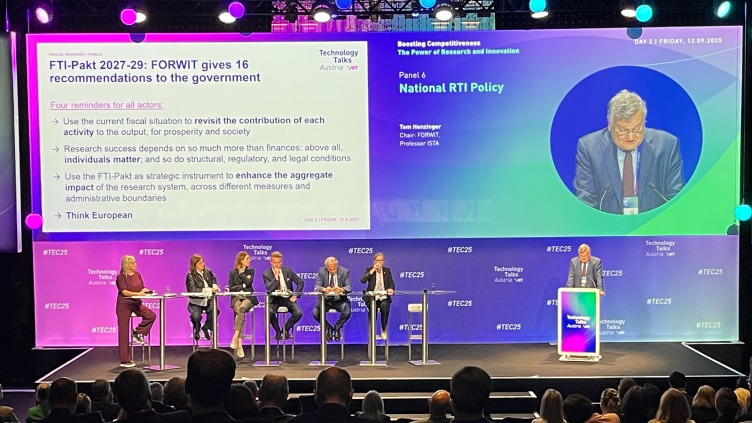
Today FORWIT – the Austrian Council for Sciences, Technology, and Innovation – published its recommendations to the government for the impending FTI-Pakt; you can find these recommendations at forwit.at. There is not time to go through all 16 recommendations, which range from Artificial Intelligence to research security; instead I want to remind the community of four key factors to make the FTI-Pakt a success.

  1. It is a cliché, but a crisis is too valuable not to be used as an opportunity for driving change. Thus I invite all actors to reconsider how much each current activity contributes to the input and output lines of the chart I showed, and to draw and execute the appropriate conclusions.
  2. Success in research depends on so much more than finances: as in sports and the arts, what matters most is the individuals carrying out the research or starting the company – they are not interchangeable. In fact, the people who have good ideas matter much more than the ideas themselves. Therefore, as a society, we cannot afford to leave any gifted child, any potential future star researcher or future entrepreneur behind, independent of gender or background. We also need to make every effort to attract young international talents. Conversely, however, we must not afford lifetime positions for researchers who are not competitive internationally. Also structural, regulatory, and legal conditions matter greatly for research success, and they may not cost anything. In this regard, our recommendations are not the first ones to stress the importance of using public procurement strategically, and of improving the conditions for private venture funding, to name just two examples.
  3. The FTI-Pakt covers only 30% of the public R&D expenditures. The other big slices of the cake concern the universities, which are funded separately, and tax credits for corporate R&D. Not only are these budget slices separate, they also have different timelines. All R&D budgets should, however, be communicating vessels. For example, a change in FWF funds – whose beneficiaries are primarily at universities – may justify a simultaneous change in the financing logic for the universities, and vice versa. What matters is the aggregate impact of the R&D system; FORWIT therefore encourages systemic optimizations across different instruments and across traditional administrative boundaries – only those can exploit redundancies and synergies effectively.
  4. Many shortcomings are best solved not on the national, but on the European level. The crucial importance of a common European capital market and a 28th regime for European startups is only one example. Put provocatively, if I were finance minister, I would prefer to spend a research Euro in Europe rather than spend a research Euro in Austria. Not only does a research Euro spent in Europe come back to Austria as more than one research Euro, more importantly, a research Euro spent in Europe is highly leveraged, because 26 other countries must put in their respective research Euros as well (in fact more than 26, because there are also associated research countries like the United Kingdom or Switzerland).

It’s time to conclude. In short: Austria has made tremendous progress in the last decades. But don’t wait until any chainsaw swingers might come to power and you will be forced to make changes; we can make much more sensible and more effective changes on our own.

Speech by Chair Thomas Henzinger as part of the panel on national RTI policy on 12 September 2025 at the Technology Talks 2025.