“Let’s build the future instead of defending the past”
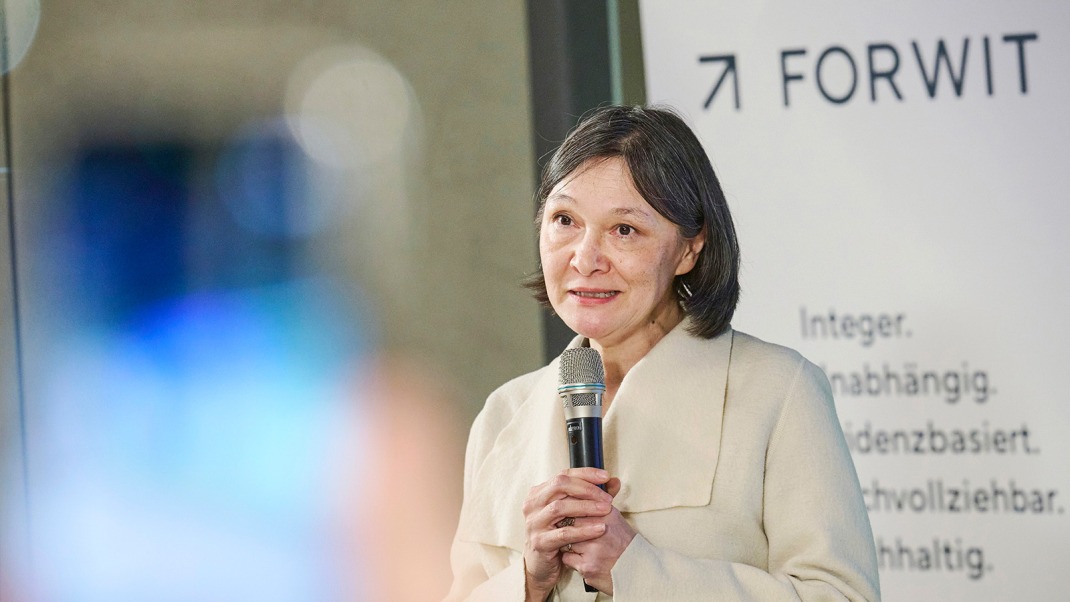
Transcript of the speech by Deputy Chair Sylvia Schwaag Serger at FORWIT’s New Year Reception on 26 January 2026.
It is a somewhat sad evening for me. Ten years ago I received a phone call – I was in Beijing at the time – asking whether I would be interested in joining the Austrian Council for Research and Technology Development. I must be quite honest: I said yes because I had been missing the German language. Over the past ten years, however, I have truly come to know and love Austria, and it will be difficult for me to leave the Council. But I will remain connected to Austria. Since this is therefore the last time I shall be addressing you in this context, I should like to broaden the focus of my speech somewhat.
Technology, Geopolitics and the Future
I should like to begin with a book I rediscovered over Christmas whilst trying to understand this world: When Trust Breaks Down from 1990. I first read it when I was studying International Relations in Bologna. One quotation struck me as particularly important then, and even more so today: “Adherence to commitments promotes harmony between states. The inclination to disregard does not. A world without honour is a world without order. To keep peace, allies would be advised to keep promises.”
The events of the past two weeks – and by that I mean the Greenland episode, which we shall hopefully describe as such in history – have shown us with utmost clarity: the world is different from a year ago. It is a world in which the Nobel Prize has become purchasable, in which eighty-year-old alliances are being undermined and the international rules-based world order is being replaced by the law of the strongest. These past two weeks have also shown us how closely economics, geopolitics, technology and security are interwoven – and how they can be played off against one another.
“When Xi Jinping speaks about the world changing fundamentally, he speaks with confidence. And we often speak with concern.”
We are in a new world order. A year ago, in October 2024, we delivered the Heitor Report; at the same time came the Draghi Report. Much has happened since then. We have seen three military parades: China, USA, Russia. And I believe I need not tell you which was by far the most impressive – the Chinese one. However, I should also like to recall a statement by Xi Jinping from 2018: “From the mechanisation of the first industrial revolution in the 18th century to the electrification of the second industrial revolution to the informatisation of the third industrial revolution – rounds of disruptive innovation have fundamentally changed the development trajectory of human history.”
What I find interesting about this quotation: we know that technological disruption will fundamentally change our lives, and whether that becomes positive or negative lies with us. But when Xi Jinping speaks about the world changing fundamentally, he speaks with confidence. And we often speak with concern.
Technology as Driver of Change
“Our geopolitical problems are rooted in technological disruption.”
This change in world order is driven by geopolitics, by the decline of democracy – which Federal Minister Holzleitner also mentioned earlier – by climate change and the Anthropocene. But above all, I would say, by technology. At a high-level event in Stockholm recently, someone said: “It is such an unfortunate coincidence that these geopolitical problems are happening simultaneously with this technological disruption.” I would argue: our geopolitical problems are rooted in technological disruption. And we must understand that.
In his article in the New York Times a few weeks ago, Thomas Friedman expressed this very well when he spoke of the “Polycene” – in reference to the Anthropocene – and said: “Science, technology, and politics are interacting in a way and at a pace not seen before.” That, I believe, is in one sentence the fundamental challenge for our democracies.
The transformation researcher Jan Rotmans quite rightly said: “It’s not an era of change, it’s a change of eras.” And technology is driving these changes. At the same time, technology does not emerge in a vacuum. To quote Bruno Latour, a well-known sociologist: “Technology is society made durable.” Last year’s Nobel Prize winner, Daron Acemoglu, and his colleagues also argue in the same direction when they say that it is our task to frame technology – we are responsible for whether technology brings us benefit or harm and whether it builds the society we want.
The source of new technologies is science, and scientific fundamental principles are global – this applies particularly to the natural sciences, for the social sciences have never been as global as the natural sciences. But politics is becoming increasingly nationalistic. How we deal with this field of tension is one of my research areas. The return of security threats and war in Europe is a sign and a consequence of the new times we are dealing with.
In our Heitor Report we wrote: when we talk about competitiveness, we often talk about the competitiveness of our economy. But I would say it is about much more. It is about the competitiveness of our systems. We are in a strategic competition where it is about the power of ideas, the power of narrative, persuasiveness and mobilisation power.
I see this at my Academy. We receive one Chinese delegation after another trying to convince us that China is the stable major power, the responsible major power. And that it is time for us all to recognise this and fit into this new world system. That is what I mean by strategic competition.
When I ask the CEOs of leading Swedish companies what concerns them, they tell me, “the USA – that is a bit irritating, a bit unpredictable, a bit unstable. But our big problem is China. If we do not know how to deal with China, we will no longer be an industrialised country in ten years.” Europe must realise: China has caught up with the lead of European countries at great speed.
What Makes China Successful?
What is China doing right? When China sets priorities, it mobilises not just the entire government, but the entire country. When we – now I am talking about Sweden, then it will not be so personal – when we set priorities, it is not the mobilisation of the whole country. It is not thousands of levers that are set in motion to make this prioritisation a reality.
“China identifies and reduces dependencies whilst simultaneously strengthening its own indispensability.”
For ten years, at the latest since the “Made in China 2025” strategy, but also earlier, China has been doing the following quite deliberately: identifying and reducing dependencies, and simultaneously strengthening its own indispensability. I believe that is something we must also focus on more. In what are we indispensable in Europe, and how can we make ourselves even more indispensable?
Then there is leapfrogging. When I was in China for the first time twenty years ago, people were already saying: “Yes, we know we cannot catch up with the combustion engine, for example; Europe and the USA are ahead of us there. Therefore we ask ourselves: what is the next technological frontier and where does it lie?” I believe we should have the confidence to do that as well.
The last point: I have met many Chinese ministers, and one always thinks one must be extremely polite. I always expressed how impressive China was. But what really impressed me was the response. “We do not need this small talk. Tell us what we can do better.” In Europe, that does not happen to me so often.
What Does This Mean for Europe?
The Key Technologies Initiative is fantastic, but very many countries have identified the same technologies. That does not mean Austria should not do it – absolutely, Austria also has unique strengths. But we must always remember: with these new technologies, size matters. That is why we must work together with others.
In the Industrial R&D Investment Scoreboard 2025, the two thousand companies that invest the most in research and development are listed. Many from the EU are not amongst them, and the top four firms from the EU are in the automotive sector. There lies an enormous challenge before us. When we group the list by countries, Germany is leading in the EU, then comes France, then Sweden, and much further down follows Austria. I find that is quite an illuminating statistic.
What can Europe, what can we do? I have summarised it thus: Europe is overregulated and underpowered. We must invest together in our strengths and in the future (keyword: indispensability), promote technology application, “rediscover the magnificence of science”, embrace creative destruction, defend the rules-based world order, develop other markets (India, Mercosur, CPTPP, etc.) and realise the Single Market. Apropos magnificence of science, I recommend the article “The Counter-Reformation of science”.
“It is a problem that we always think we must invent everything ourselves.”
Focus much more on technology diffusion and application. It is a problem that we always think we must invent everything ourselves. Historically, one sees that this is not the case. The country that develops the technologies is not necessarily the country that profits from them. And of course the Single Market. “Europe is afraid of its own power,” said the Ukrainian ambassador at the annual security conference in Sweden – which I found very important and very correct.
I have spent the past two years, together with a few authors – Soete, Johan Flenner, Michael Landabaso – and based on contributions from a group of experts, writing a text: Capitalism, Sustainability and Democracy [forthcoming, Ed.] – in reference to Schumpeter’s Capitalism, Socialism and Democracy. We see Europe’s opportunity in the fact that Europe is the only region that can productively connect these three cornerstones of this triangle with one another.
The USA is currently abandoning sustainability and we do not know how its democracy stands. China has decided against democracy and is now very successfully pursuing capitalism, but also sustainability. Europe is, in my opinion, the only region where we can meaningfully connect these three cornerstones with one another. But at the moment they are undermining one another.
Austria
Austria has many things that others envy. I have been able to observe this over the past ten years. There are extremely many bright minds here and excellent research. It has such things as IST Austria or the Complexity Science Hub, which I envy Austria very much – I have been trying for years to establish something similar in Sweden. The STI Monitor, the RTI Pact, and this incredibly impressive development of the R&D ratio – that should also be mentioned again.
“Is it really an initiative for key technologies that is supported by the whole government – and not just the government, but all relevant actors?”
I find the Key Technologies Initiative extremely important. It is an important signal to show that one is prepared to set priorities. But I also ask myself: is the prioritisation effective? Here I refer again to what I said about China: is it really an initiative that is supported by the whole government – and not just the government, but relevant actors in research, business, society, who mobilise and pull together?
This was also mentioned: we have a new era. But are we developing new tools that enable us to deal with this new era? I would say no. We are still using the same tools. And that is a big problem.
On Monday we had a seminar which the Swedish Defence Minister was supposed to attend. Seven hundred people had registered. He had to cancel due to Greenland. But what I heard in conversations with people who work at the very top of the Swedish government – and what I also hear increasingly in other contexts: the Nordic countries increasingly have the feeling that they can only rely on their neighbours, that parts of Europe do not understand or acknowledge the existential security threat posed by Russia. And that worries me, because for ten years I have felt that Austria and the Nordic countries would benefit greatly from working together. But at the moment the impression is growing that the other countries, not least Austria, do not understand what we are dealing with and are not prepared to actively and concretely commit themselves to it. Perhaps the Nordic and Baltic countries are the only ones we can rely on. And that worries me for the cohesion and future of Europe.
Connecting Knowledge and Action
Joel Mokyr was one of the Nobel Prize winners we were able to welcome to our Academy and I had a fantastic experience interviewing him. Mokyr always speaks of propositional and prescriptive knowledge. I should like to give this to Austria as well: it is not enough to be good only in basic research. “You have to study things and you have to make things.” This connection is what distinguishes leading countries.
“How does creative destructive power stand in Austria?”
Then I would lean on the Nobel Prize winner Philippe Aghion, who spoke about Schumpeter’s creative destruction. And here I should like to ask the question whether Austria is perhaps a bit structurally conservative, that is, has conservative structures? And how does creative destructive power stand in Austria?
Apropos creative destruction, a warning from a former staff member in the Office for Science and Technology Policy under Obama and Biden is constantly present in my mind. He said: “I do not wish on anyone what we are now experiencing with our president. But I wish we had tackled some of our problems more seriously when we had the chance. We had real problems in the American research system, and by not addressing them, we lost credibility (in science but also in democracy).” That is something that also concerns me with regard to Europe: we must address our problems so as not to open the door to something similar to what is happening in the USA.
Dual Use and Futures Research
Here I wanted only to show: Vinnova, the Swedish innovation agency, together with the German SPRIN-D, has issued a call for proposals for dual-use anti-drone initiatives or tools. I find this collaboration between two innovation agencies from two countries on this topic extremely interesting and sensible. The Swedish Foundation for Strategic Research has something similar – to my knowledge the first official call for proposals for dual use.
At my Academy we have launched the initiative Swedish Futures. We must of course work in an evidence-based manner, but we must also imagine the future. As the first member state of the EU, we have therefore commissioned exactly the same technology analysis for Sweden that underlies the Draghi Report. The report had a great effect: suddenly quite different actors are talking about Sweden’s technological strengths and weaknesses than we are actually accustomed to.
Closing Words
I am at the end. What I take away: if we want to shape this future for ourselves, it is about self-confidence – in a double sense of the word: “know yourself” and “believe in yourself”. It is about imagination, and it is about capacity to act and willingness to act. Here I come back to Thomas Friedman, who said: “The most adaptive, resilient and productive communities in the polity will be those that can assemble complex adaptive coalitions.” We have launched such a complex, adaptive coalition in which we bring together the trade unions, the largest Swedish companies and all the other stakeholders to steer Sweden’s future in the right direction.
I have followed Austria’s catching-up race of recent years with great interest, great passion and great admiration. But I must simultaneously say: catching up is no longer enough. I believe we in Europe have the wrong frames of reference. In Austria one always wants to catch up to the Innovation Leaders. Who are the Innovation Leaders of the future? I do not believe that today’s European Innovation Leaders are necessarily the future global Innovation Leaders, if things continue as they are. We must therefore consider: whom and what should we orient ourselves by?
These are unique times. Joel Mokyr said: “Don’t think out of the box. Break the box.” I would take that with me, because otherwise we will not get anywhere. The other is a greater focus on results and less on processes.
“I would encourage the Austrians to believe more in themselves. Austria has incredibly much to offer Europe.”
In conclusion, I want to emphasise once more: it has been a tremendous honour to serve Austria. I did it because I believe in Europe and because Europe needs Austria. An appeal to Austria: believe more in yourselves. The Swedes have a healthy self-confidence, and that is important and positive, especially in times like these. It gives strength to act courageously. I would encourage the Austrians to believe more in themselves. Austria has incredibly much to offer Europe, and it is time for Austria to confidently take the step from follower to leader – with everything that entails.
I must be quite honest: I am more optimistic today than I was two weeks ago. The response that Europe has shown to the Greenland episode gives me confidence. Therefore I hope that we dare to build the future instead of defending the present and the past.
Thank you very much.
***
This is the transcript of a speech by Deputy Chair Sylvia Schwaag Serger at the opening of FORWIT’s New Year Reception 2026 on 26 January 2026 in the Austrian Parliament.