On the efficiency of research, technology and innovation in Austria

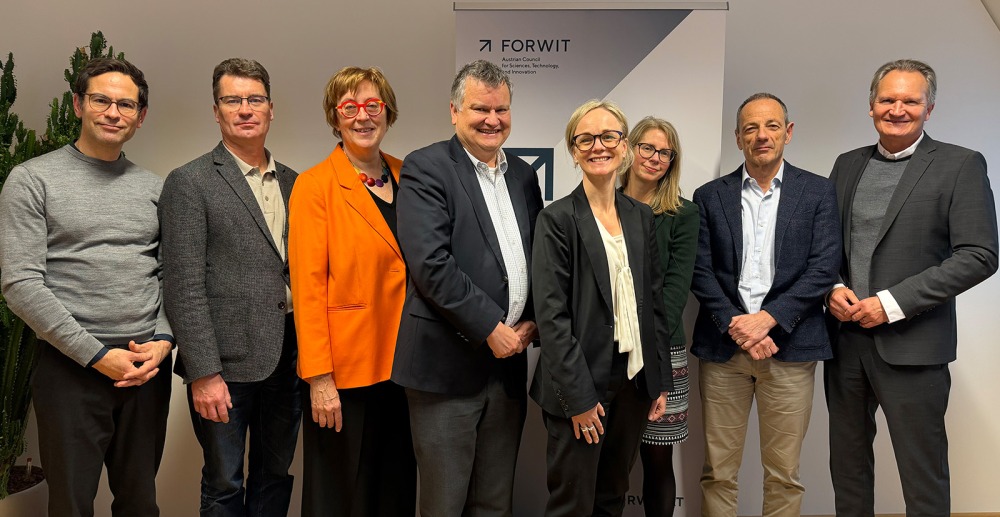
At the end of May, FORWIT presented its annual analysis of the Austrian STI system in Parliament. The STI Monitor provides an international comparison of the performance of the Austrian STI system based on more than 280 indicators. This analysis is freely accessible and intuitively designed, allowing different perspectives on the STI system, from the framework conditions, through the core system and cross-cutting themes, to its impact. The following summary represents only a small excerpt from the extensive analysis by FORWIT. Based on the presentation on 26 May 2025, it focuses on the innovation processes in the STI core system by comparing policy indicators for performance support (input indicators) and performance indicators (output indicators).
Methodologically, the efficiency measurement follows Data Envelopment Analysis, a multifactor productivity analysis model for estimating relative efficiency. The presentation begins with a critical assessment of the efficiency of the science system (including higher education and non-university research and their funding) and then analyses the entrepreneurial STI performance in Austria. Special attention is given to the competitiveness in STI measured by key technologies, which has been included as a new category in the analysis. Finally, the use of the transformative key technology Artificial Intelligence (AI) in Austrian companies is examined in more detail.
I. Efficiency and the Dimension of Science
Scientific Sector
The composite indicator “Science” in area D.2 Efficiency, which represents an average of all related indicators, shows a relatively constant development for Austria below the level of the comparison groups. An interesting comparison point is Iceland, which has been among the top three countries since 2024. Despite its small size, Iceland has achieved a leading position worldwide through early and consistent focus on niches such as genomics and the central use of health data. This underscores that even smaller economies can achieve international visibility and leadership roles through clear research policy focus and strategic specialisation. In contrast, Austria pursues a more diversified approach aimed at the breadth of the innovation system.

Higher Education and Non-University Research
R&D Expenditure: Measured as a share of GDP, Austria ranks second (behind Denmark, ahead of South Korea) among the top nations. This indicates a high political prioritisation of R&D. In terms of actual expenditure per capita (measured in US dollars at purchasing power parity), Austria is above the average of the Innovation Leaders, with Switzerland leading.
Number of Researchers: Austria has a value of 2.35 (in full-time equivalents). Greece is notable in the top three, which is due to a strong concentration of R&D activities in the public sector. In contrast, the industrial R&D base is weak compared to Austria.
Funding
Private Funding Share: In Austria, around 66.9% of gross domestic expenditure on R&D (GERD) is financed by the business sector. Although this is two-thirds of all expenditure, it is slightly below the EU average. A high private share is positive as it indicates a strong link between R&D and value creation, and thus a market-oriented innovation dynamic. Ireland is a top country here due to the presence of global tech and pharma companies, favoured by low taxes.
Public Funding (Higher Education Sector): Austria invests around 0.6% of GDP in R&D in the higher education sector, making it one of the top three countries. The country traditionally has a strong public FTI sector with universities, non-university institutions, and universities of applied sciences. This supports the many small and medium-sized enterprises (SME) that often conduct R&D in cooperation with these institutions.
Indirect Funding: The Austrian research premium of 14% is a strong location policy instrument but is not statistically attributed to the private funding share. This potentially leads to an underestimation of the private contribution. Internationally, Austria has slightly fallen behind in this form of funding and ranks ninth.
Project-Funded Basic Research: In project-related funding for basic research, Austria’s per capita funding is comparatively low, indicating a below-average level compared to the nine countries considered.
Scientific Output: Publications
Number of Publications: Per 1,000 inhabitants, Austria is above the EU average. Switzerland, which has a particularly high publication density, Denmark, and Norway lead here.
Quality of Publications: Measured by the share of publications that belong to the top 10% most cited worldwide, Austria shows high scientific relevance. Austria achieves above-average results in relation to the input in the fields of medicine, physics, materials science, and computer science.
II. The Dimension of Technology: Corporate RTI
R&D Expenditure of Companies: As a share of GDP, Austria is well above the EU average and the benchmark of the Innovation Leaders. Leading nations such as Israel, South Korea, and the USA are driven by billion-dollar corporations in sectors such as defence, biotech, and IT, while Austria’s sector is heavily SME-oriented and, like Germany and Sweden, has a broad product portfolio.
Innovative Companies: The number of innovative companies is slightly declining. This is due to methodological reasons (a stricter definition of innovation in the survey), economic reasons (uncertainty due to the pandemic, inflation), and structural reasons (declining innovation activities in traditional industries). Cooperation with Universities: Cooperation is also declining, which is also due to a changed survey methodology. Only clearly defined projects are counted, not pure networking meetings or events as in the past.
Export Quality: Measured by price as a proxy for technology content, Austria shows a significant increase. This is due to industry-specific specialisation and the development towards technology-intensive components, but is also influenced by inflation.
Knowledge Intensity of Exports: The share of products with medium to high technology intensity is relatively stable in Austria, indicating a broad and diversified export structure. In contrast, Hungary has a narrower export focus (e.g., automotive), where knowledge intensity often arises from production for foreign companies, while R&D takes place elsewhere.
Innovation Revenue of SME: Here, there is a marked decline, mainly due to economic uncertainties and a redistribution of investments away from marketable product innovations towards internal optimisation measures, particularly in the areas of digitalisation and automation. As a result, fewer innovations with scaling potential are currently reaching the market. In addition, technological innovations typically require longer development and lead times before they become economically effective.

III. Competitiveness and Key Technologies
Innovation is a central lever for competitiveness. The STI Monitor has therefore been expanded to include the area D.3 “Competitiveness in STI”, which is analysed based on key technologies. Patent data, considered a robust indicator, serves as the basis. The analysis is based on five metrics: (i) number of patents at the European Patent Office (EPO), (ii) patents per capita for international comparability, (iii) Revealed Technological Advantage (RTA) as a measure of technological specialisation, (iv) triadic patents (applications in the EU, USA, Japan) as an indication of commercial significance, (v) citation weighting as an indication of quality. Austria files most patents in the areas of production technologies, digital technologies (especially micro/nano-electronics), and material technologies.
An example shows that high national specialisation (high RTA) does not automatically lead to an international top position: In the area of the Internet of Things (IoT), Austria has an above-average specialisation but ranks only 19th internationally. Comparing 2015-2019 to 2020-2022, there is a decline in robotics (both in patent applications and specialisation), while Austria has improved in photonics and advanced materials. The qualitative significance of patents, measured by citations, was lower in almost all technology areas in 2020-2022 than in the previous period.
Focus: Artificial Intelligence (AI)
In the area of Artificial Intelligence, Austria performs below average in all indicators. Advanced AI methods such as machine learning are rarely used; instead, text analysis and chatbots are primarily utilised. The use is mostly isolated in individual departments, lacking a structured approach in implementation and strategic, company-wide integration. Barriers include lack of competence, high costs, and data protection concerns. Notably, most surveyed companies indicate that they currently see no benefit in using AI.

IV. Conclusion
Austria’s STI system presents itself as a complex structure with clearly recognisable strengths and existing challenges. The analysis shows that the country has remarkably high scientific quality and productivity, reflected in the international recognition of Austrian research achievements. Particularly noteworthy is the traditionally strong research cooperation between science and industry, which forms an important bridge between theoretical knowledge and practical application. This close interconnection is also reflected in the technology-intensive product exports, which underline Austria’s position as an innovative business location.
Despite positive aspects, the analysis also highlights structural weaknesses that could jeopardise Austria’s future competitiveness. Significant deficits are particularly evident in the introduction and strategic use of Artificial Intelligence and the comprehensive digitalisation of the economy. These fields are increasingly becoming central drivers of international location attractiveness – making the existing deficits all the more concerning. Additionally, there is a significant lack of private risk capital, which hampers the development of start-ups and spin-offs, thus limiting the dynamics of the innovation ecosystem. Furthermore, the potential for the economic exploitation of scientific findings remains insufficiently tapped – an indication that the transformation of research results into marketable innovations is not yet consistently successful.
The overall view makes it clear that research, technology, and innovation remain central pillars of Austrian economic and location policy. To avoid falling behind in the intensified international competition, continuous and strategically oriented investments are essential. It is crucial to preserve the existing strengths while simultaneously addressing the identified weaknesses to secure Austria’s position as an innovative location in the long term.