Report on the 8th session and visit to Berlin

The 8th FORWIT Council session was held in conjunction with a special event in Berlin: the Falling Walls Science Summit, which takes place annually on 9 November to commemorate the fall of the Berlin Wall.
The Falling Walls Science Summit brings together top researchers, science managers, and representatives from politics and intermediary organisations. Participation offered the members of the FORWIT Council the opportunity to engage in numerous discussions with young and established, creative scientists, researchers, and entrepreneurs, and to strengthen FORWIT’s international network.
As part of the conference, two FORWIT side events were organised. An exchange on scientific policy advice took place with Alena Buyx, Professor of Ethics in Medicine and Health Technologies and Director of the Institute of History and Ethics of Medicine at the Technical University of Munich. There was also an opportunity to meet Tayebeh Saghaei and Francesca Kastner, the winners of this year’s Falling Walls Lab pitches in Austria.


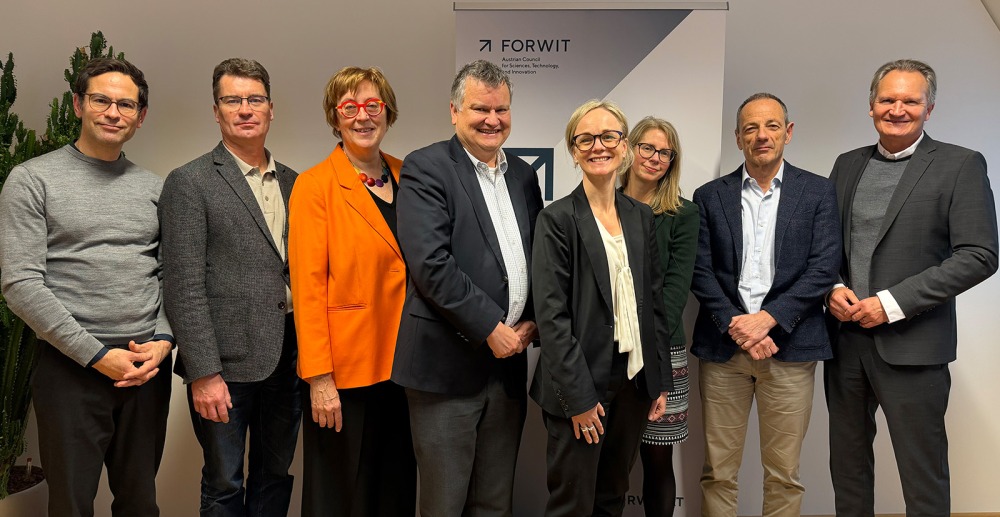
On the day after the conference, 10 November, FORWIT had the opportunity to hold its Council meeting on the premises of the Austrian Embassy in Berlin. The two main topics of the meeting concerned the implementation of the 2026 work programme and a discussion of the research, technology and innovation policy initiatives anchored in the government programme.
The stay also provided an opportunity to exchange views with Irene Bertschek, the new Chair of the German Expert Commission on Research and Innovation (EFI), and Helge Dauchert, Head of its Secretariat. During a flying lunch, there was an in-depth dialogue about the working methods of advisory structures, as well as the thematic priorities pursued by the two councils. In particular, the discussions focused on how Austria and Germany might succeed in translating scientific research results more rapidly into technological developments and successful enterprises, and on which initiatives at European level should be jointly supported or pursued in order to help close the emerging technology gap between the EU’s research and economic area and other global regions.


Another highlight of the delegation’s visit was the FORWIT panel discussion on the theme “Rethinking Competitiveness: Capital Markets Union, Start-ups and the Role of Policy in Europe.” Elisabeth Riederer, Minister, welcomed around 100 guests to the event hall of the Austrian Embassy. The panel featured Georg Kopetz (FORWIT), Irene Bertschek (Chair of the EFI), Jano Costard (German Federal Agency for Disruptive Innovation, SPRIND), and Ron Melz (CEO of Spine Energy).
The panel discussion conveyed a clear message: Germany and Austria continue to play leading roles in key areas of scientific and technological development, yet international competition remains fierce, and the successful market launch of innovative products and the diffusion of new technologies into companies are progressing less effectively. In particular, limited access to private venture capital poses challenges, especially for young companies in their growth phase. A promising avenue for retaining investors in Europe while fostering growth and stability lies in the harmonisation of financial regulations and the creation of new financing instruments for green and digital investments within a common Capital Markets Union.
Einen weiteren Höhepunkt der Delegationsreise bildete die Podiumsdiskussion des FORWIT zum Thema „Wettbewerbsfähigkeit neu denken: Kapitalmarktunion, Start-ups und die Rolle der Politik in Europa“. Elisabeth Riederer (Gesandte) begrüßte rund 100 Gäste im Veranstaltungsraum der österreichischen Botschaft. Am Podium diskutierten Georg Kopetz (FORWIT), Irene Bertschek (EFI-Vorsitzende), Jano Costard (Deutsche Bundesagentur für Sprunginnovationen (SPRIND)) und Ron Melz (CEO von Spine Energy).
Der Tenor der Podiumsdiskussion war eindeutig: Deutschland und Österreich nehmen nach wie eine führende Rolle in wichtigen Bereichen wissenschaftlicher und technologischer Entwicklung ein, doch der internationale Wettbewerb ist intensiv und die erfolgreiche Markteinführung innovativer Produkte und die Diffusion neuer Technologien in die Unternehmen gelingt weniger gut. Insbesondere beim Zugang zu privatem Risikokapital bestehen Engpässe, die vor allem junge Unternehmen in der Wachstumsphase vor Probleme stellen. Eine Chance, Investor:innen in Europa zu halten und Wachstum und Stabilität zu erhalten, wird in der Harmonisierung von Finanzvorschriften und Schaffung neuer Finanzierungsinstrumente für grüne und digitale Investitionen, im Rahmen einer gemeinsamen Kapitalmarktunion gesehen.

 Steven Lelham
  Steven Lelham