STI Monitor 2025: Austria’s competitiveness in STI
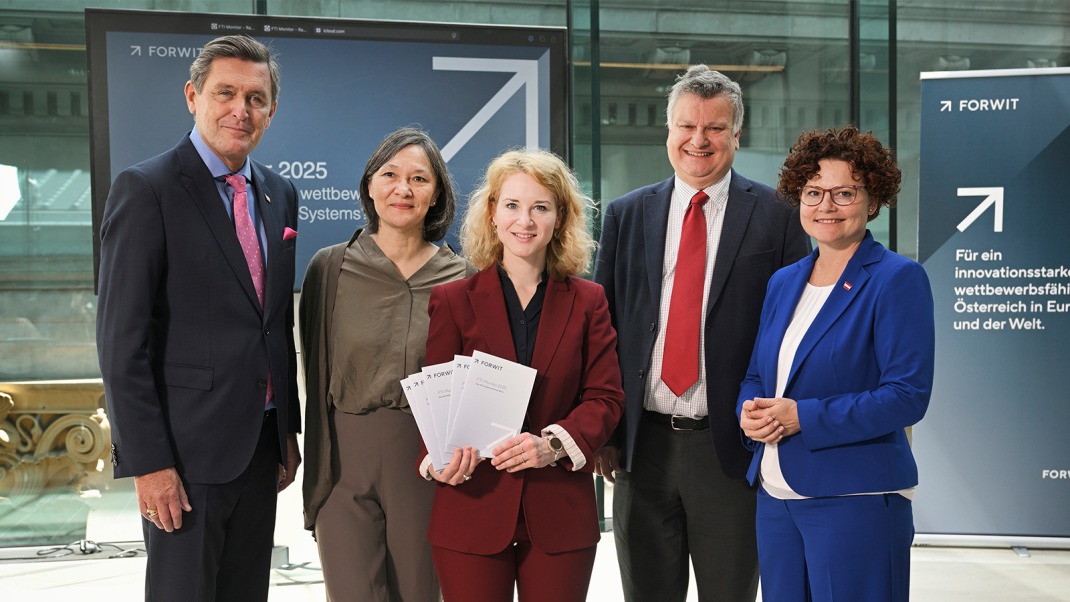
On Monday, the Austrian Council for Research, Science, Innovation and Technology Development (FORWIT) presented the STI Monitor 2025, which provides information on the current performance of the Austrian STI system. In addition to the latest findings on national innovation processes, the presentation focussed in particular on the two new areas added this year: Competitiveness in STI and Artificial Intelligence.
Austria’s national strengths do not automatically lead to top international positions
An analysis carried out by WIFO on behalf of FORWIT sheds light on how many patents are registered in Austria in various key technologies and how strongly the country has specialised in them.
This shows that Austria’s performance has improved significantly in recent years, particularly in the key technologies of photonics, advanced materials and quantum technology – both in terms of the number of patents and the degree of specialisation. In photonics, for example, the country ranks among the top 5 internationally in both aspects, and there has also been progress in specialisation in the areas of IT for mobility and the Internet of Things. However, the country often falls behind in terms of the international significance and citation frequency of its patents – an indication of its lower economic and technological importance. Countries with a significantly higher number of large technology-intensive companies, such as Switzerland, the USA or Japan, are usually better positioned here, develop faster in some cases and specialise more strongly, meaning that Austria’s domestic strengths do not automatically lead to top global positions.
Those who can keep up in the technology race can keep up everywhere.
Sylvia Schwaag Serger
“For Austria – but also for Europe – the goal must be to become internationally competitive in key technologies. Those who can keep up in the technology race can keep up everywhere. This is because such technologies are geo-economically and economically important cross-cutting issues that require and affect all areas of society – from education and social affairs to science, business, politics, security and defence – in equal measure. Strength in key technologies can therefore also be seen as a product of the strength of an entire society,” says Sylvia Schwaag Serger, Deputy Chairwoman of FORWIT.
Companies are increasingly seeing barriers to the use of AI
As such a broad cross-sectional technology, companies must therefore also be able to use artificial intelligence sensibly and effectively in order to keep up internationally. Although Austrian companies are catching up in the entrepreneurial use of artificial intelligence (AI), they only reach 73% of the performance level of the Innovation Leaders.
In 2024, just under 20% – around twice as many as in 2023 – of Austrian companies with ten or more employees used at least one AI technology. Although this is above the EU average, it is below the level of the European Innovation Leaders Denmark, Sweden, Finland and the Netherlands, where around a quarter of companies use AI. Austria also lags behind leading countries such as Finland and the Netherlands (> 6%) in the highly relevant use of AI in research and development with only 3.8% of companies. In addition, the number of companies that see no benefit in the use of AI is increasing, in contrast to the Innovation Leaders and the EU27.
Smaller companies in particular find it difficult to strategically integrate AI into their processes. Legal uncertainties and a lack of expertise, but also insufficient data quality and technical incompatibility are perceived as important reasons for this. It is not the technology itself that is lacking, but rather the structures, expertise and clear framework conditions. Austria should offer targeted support in the area of the key technology of artificial intelligence so that companies – especially the many small and medium-sized enterprises – can utilise it better to their advantage. This includes assistance with knowledge transfer to encourage innovation.
Competitiveness in research, technology and innovation is the foundation for growth, security and future viability.
Thomas Henzinger
“Competitiveness in research, technology and innovation – especially in transformative technologies such as artificial intelligence – is the foundation for growth, security and future viability. We can only secure prosperity, respond agilely to global challenges and promote European independence in the high-tech sector if we play a leading role internationally and utilise these technologies correctly. Science and innovation guarantee that Austria remains resilient, creates new jobs and is recognised as an attractive location for talent and companies,” says Thomas Henzinger, Chairman of FORWIT, emphasising the importance of research, technology and innovation.
The complete analyses and results of all 18 areas of the STI system are now available in the STI Monitor 2025.
About the STI Monitor
With the STI Monitor, FORWIT makes a significant contribution to evidence-based policymaking in Austria and provides an international comparison of the performance and competitiveness of the Austrian research, technology and innovation system. Visualisations of the development over time and long-term changes as well as trends, input/output performance and the degree to which the goals of the STI Strategy 2030 have been achieved provide stakeholders and political decision-makers with a basis for strategically and systemically effective decisions and actions. As the federal government set itself the goal of making Austria an innovation leader by 2030 in its STI Strategy 2030, the average of the current innovation leaders in the European Innovation Scoreboard (EIS) serves as a benchmark. Austria can also be compared with the EU27 and the global top 3 in the respective field.